household accounts

tortoise

Trooper

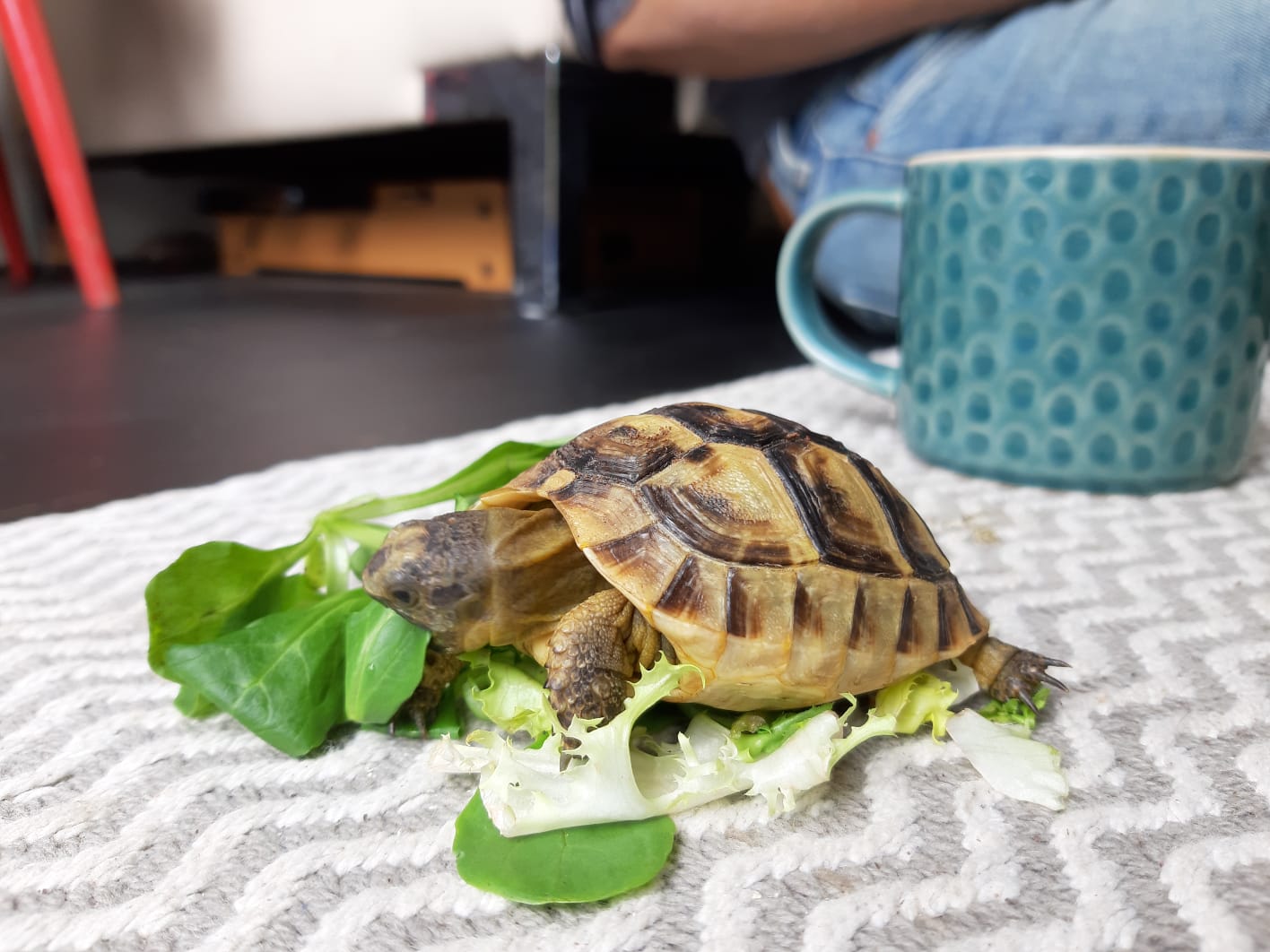
During lockdown, my boy and I side-stepped the cockapoos and labradoodles and other needy creatures, and bought a tortoise. 

Cites certified. No longer common-place: Happily, the days when crate-loads were brought from sunny wild places to our damp gardens to die of our careless misunderstandings, belong in the past of my childhood, not in my son’s. 

We didn’t realise how terrifyingly tiny a nine-month-old tortoise was until, invited to choose him from among tortoise brothers and sisters, my boy picked him up to find he barely filled his hand.

I begged to call him ‘Zoom’ because he didn’t and at the time, everyone else did. 

Sensibly my boy put my joking aside. Observing that his shell looks like a World War soldier’s helmet and from that, understanding something of his nature, my boy named him ‘Trooper’. The naming of a tortoise, is every bit as grave a matter as the naming of cats.

If things turn out well, troop he will, through many years, maybe more than 50. Some tortoises live to 75. It is sobering to know that if we do this right, Trooper will easily outlive me and he could outlive us both. Me in my half-century, my boy in his 10 per cent.

My son didn’t miss the irony that I had said no, to an earlier offer of a baby gecko once I realised they live 15 years. “Oh but, the live crickets”, I said. 

Tortoises are vegetarian. Having clinched the deal and surprised that I had said yes at all let alone so quickly, my boy promised me he was ready for the life-long responsibility. Then he and I promised each other, solemnly, that we would remember to leave tortoise to our children in our wills.

Tortoise-housing being hard to come by in lockdown, we cajoled our handy neighbour to make a big ‘tortoise table’ and one exciting day, the most eventful in a long time, we brought the baby tortoise home. 

Trooper will grow to the size of a small melon, but for now he sits in the palm of my hand. His front legs are heroically spiked. He is a Spur-thighed Iberian. We have claimed him as Greek, though in truth his is a scattered turkish sort of wandering greek from further along. The sort that existed before nation-building Attaturk burned the greekness out of ancient trading cities. 

Moving in such a way with such a wiggle that his wrinkled graceless back legs remind me of the cutest chubby human baby-crawling, pushing onwards, from under the frilly rear of his shell. He walks on his claws as on tippy-toes, scratching and tickling our hands.

Waiting watchful, as time warms our blood like sunshine we are learning to live in tortoise-time.  As he warms his lash-less lids blink over poppy-seed eyes. Dark and shiny as oil. Looking at each other and nodding in tortoise greeting, we know we cannot cross into each other’s particular sort of time and space for long, but we are growing to understand each other well enough. 

Mostly he is slow and sleepy but when charged by solar power,  and motivated by an appetite for dandelion leaves and clover, he stretches out his wrinkly neck, and embarks on surprisingly speedy and resolute manoeuvres. If he can push his way through an obstacle, he will. If he can see the horizon he heads for it, with determination. 

Encased, his tough shell exposes his utter vulnerability. Pale green belly plastron, geometric shell embellished with green, gold and black scoots. Did you know that tortoises can feel through their shells, being both as tough and tender as human finger-nails in nail beds?

Lockdown made our own time race, and stand still. As our horizons widened to places we had never heard of before, we were not allowed more than a walk around the block. Confined together at home when we emerged we were like newborns, taking in big lungfuls of air. Suddenly all too conscious that breath becomes air becomes breath and in becoming breath becomes air all over again. 

When time slowed for me like this before, it came upon me quickly and caught me alone. This time, it came upon us all, and with more warning. On the last day before everything closed, me and my boy went and had our hair cut, and I carried home a disinfecting cleaning spray, a pack of polenta (Waitrose was clean out of pasta), and a four-pack of loo roll, not more so as not to look greedy, but enough. 

We were ready enough, and by now I knew how mundane catastrophe can be. 

The last time something like this happened, when I needed to find stillness in the middle of the storm, I would climb into my son’s bed and floating in the darkened room with a nightlight for the moon, we would cuddle as I read him bed time stories. Sweet two-and-a-half he delighted in reading the same stories over again and again. But later each night, alone in my own time, I stopped my childhood habit of reading the last page first and the thrill of reading ahead a little before placing the bookmark back a bit. I was scared and too agitated to concentrate on anything beyond the present racing moment. I stopped reading for myself, altogether. 

Seeing him so small then, chubby legs, walking on the tips of his toes, pushing himself forwards with a wiggle of his nappy, I knew I had to walk with him longer and further than his little footsteps could take him yet. He was far far from ready to walk his own way towards the horizon. I didn’t know if I could go with him but I did, one step at a time, one breath at a time, not planning beyond the next hospital appointment, not booking the next summer’s holiday, not organising teatime playdates beyond the next week of school. Until almost before I knew it, we were here eight years on and it was discombobulating that as the world grew bigger while rapidly contracting, I felt the relief of the familiar. 

I welcomed the simplification because it had become the only way I really know how to live. I was content again with my boy in our night-time boat, because in truth, I had never disembarked, never reached the shore. 

I thought how nice it might be to get a puppy so that all three of us could walk, and enthusiastically share a common purpose, but walking wasn’t that much fun when everything familiar had become strange because you had to swerve away from every other human and their nonsensically enthusiastic dog. Besides, at least one or two of the cats would probably have left home in a huff. 

So this time, when it came to the end of the everyday and the new was far from normal, I didn’t want to walk anywhere with anything.

I wanted to slow down every breath, every moment, and blink my dark eyes in the sun.

I wanted, knowing that the last page is there , not to skip ahead and read it yet, but simply read the story in between. I wanted to grow my own tortoise-shell, being so tender inside and learn to live in tortoise-time.

What I wanted, all along but didn’t know it, until my son pestered me a little during lockdown, was to know mortality and still to dare – to have a tortoise. 
sea mist

sea mist

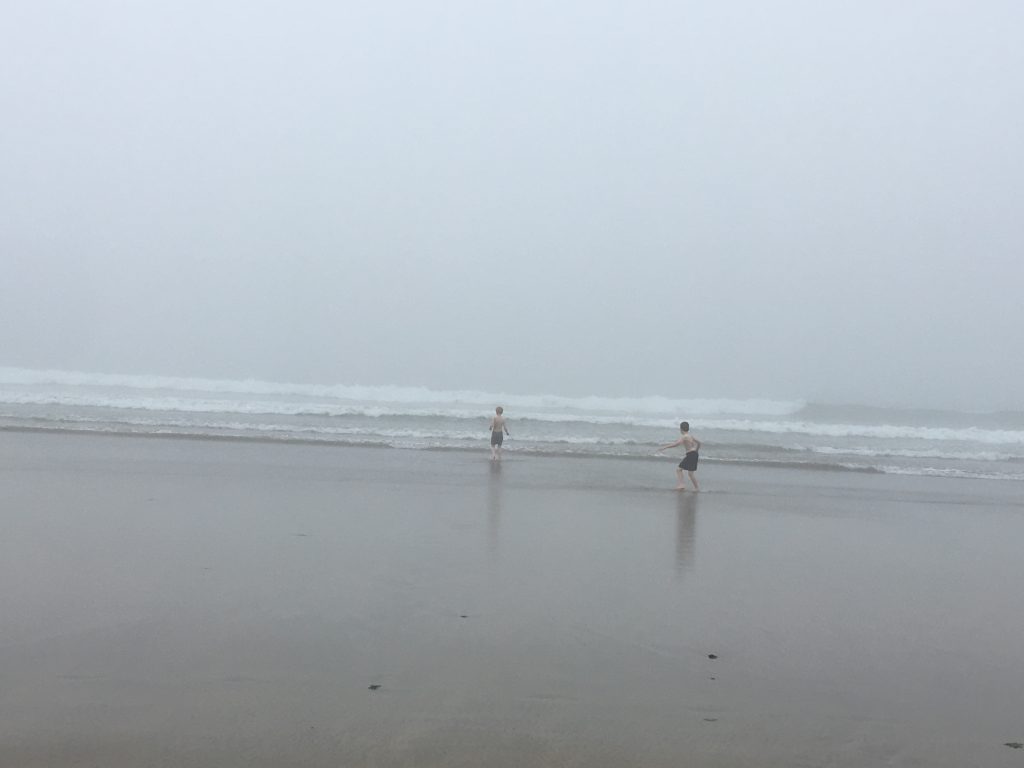
It was a day when the sea mist was so low that we were paddling in clouds. I was going to say swimming in them, but it was too rough for that in the Atlantic even in summer.

We were five: two mothers, three boys between us. Missing their fathers though in very different circumstances of time and permanence.

It was the two youngest boys who brought us together. They found each other first because we were two of the most lax school-gate mothers who allowed them (aged 8 then), virtually unlimited access to the world of online gaming. Their friendship was forged in Minecraft building projects and in Fortnight skirmishes which soon spilled over into in real life games and playground dance moves. 

As we grew to know each other too, it was a pleasure to find we shared an inclination towards libertarian parenting, a love of cats, and of singing intricately structured renaissance music.

All three of our boys will stop in the street to say how’do you do to a cat and they know to treat them with gentle accommodation. 

All three like to make a lot of noise: Shouting and shrieking with laughter at video games, rocking out on their first electric guitars. Messing around together making beats and silly videos when they should have been in bed. Modest, soulful, clever H, shown once, then picking out Bach from start to finish on the piano. L singing his heart out in tune and in time, as my heart swells.

They can be heartbreaking and hilarious, often in the same moment: The time I woke with a shock at 3 am during that great misnomer ‘the sleepover’ to see them standing, pale little-walking-wraiths at my bed side – A staring at me hollow-eyed, ruffle-haired, and struck silent by sleep deprivation, as my equally tousled boy gravely explained the situation: the thing is Mum, A spooked himself, can hear something tapping outside, can’t sleep, has to go home, so you need to phone his mum. Now Mum. So will you?

I shuffled out of bed murmuring some gentle nothingnesses, as I shepherded them back to bed. The next morning, my story of their overwrought night-visitations had us doubled-up with laughter.

All three are forensic experts at examining the arbitrary nature of whatever it is the grown-ups are telling them to do or not to do:  Why is the whole class banned from playing tag because the boys were fighting, when you know Mum, the girls weren’t playing Tag or fighting.  Or on bringing home, laminated achievement certificates, saying with a shrug come on Mum you know by now, everyone gets at least one every year.

Last summer, Grandma, being by some measures the most grown-up, made the entirely arbitrary decision to move to Portugal. This gave the rest of us a marvellous excuse for a holiday and so here we were, five of us having a bit of an adventure at the seaside.

Getting here involved a bus, a complete lack of any knowledge of Portuguese and only a vague idea of where we were going. Initially stony-faced with none of the obvious charm of their near-neighbours, our fellow passengers turned out to be very kind. They pointed us to the right bus and once on it, they counted stops for us and raised a smile for our scruffy children. 

When we reached the end of the ride, the way to the beach was through a wetland park and beneath an underpass so that we came upon it around a corner carrying our bags filled with towels, and bottles of water , suncream and snacks and suddenly the sea and sky were so big and the horizon so heavy with mist, that we adults had to stop and catch our breath and work out where one thing ended and another began.  

Our boys seeing freedom and sand, did not hold back. They ran ahead flinging off their shoes for us to pick up. As if we didn’t have enough to carry. 

Earlier in the day on the way to the bus stop all three boys had scrambled up the base of a huge war memorial. Portugal’s own Nelson’s column, but without any of the air of Whitehall bureaucracy surrounding Nelson’s figure. At the top of this column a gigantic gaping-mouthed lion stands back arched over an eagle it has killed. The eagle’s once proudly-held head hangs over the edge its throat exposed, its broken wings spread wide. This  statue of triumph of  a righteous war can be seen for miles. No pity or mercy in it, only the simple horrors of pure power. A rape of Leda. Poor Parisian pigeon killed by the swinging-balled tom cat of an Anglo-Portuguese alliance. At the base are more literal and horrific scenes of war at land and sea, figures captured twisted by the effort of living and dying by cannon fire and ship-wreck. Gasping-mouthed-hollow-eyed souls – drowning in blood and sea-foam. 

Our boys clambered among the gigantic figures, as close as they could get by climbing the base. We took dozens of photos and even though the eldest had reached the age where his long fringe came down like a curtain between him and the world, they were all so happy and excited that even he forgot himself and smiled in some.

Now at the wide beach, H found a rocky outcrop as a lookout and sheltered place to sit and read The two younger boys carried on running to the sea. Together they faced the crashing white waves and yelled into the wind for their father Poseidon to come and play.

They wrapped seaweed as bracelets around their arms and made olympian wreaths of it. They dug trenches that filled and flooded as quickly as they dug. 

A held up a mussel shell in front of his eye, vivid purple as a bruise. Dark amber eyes, copper hair a flaming sun burning through the hazy sky. They played and shouted and splashed, pale-shining, running in the wet sand.

Looking at our boys standing tall but still so small against the horizon, it was unimaginable how those early explorers could look into the fearsome churning water not knowing what lay beyond the fog and ever set sail. It may as well have been a voyage to the moon. Even more terrifying, than the moon because we know her face. These men set sail across the oceans to find a veiled bride, with what feverish dreams of taking her and her rich dowry?

When we had had enough for now of the sun and wind and sea, we walked along the quiet wide promenade to find ice cream and somewhere sheltered to sit. We were happy and tired and nearly ready for the bus ride back to the city.

A tall slender African man had laid out carved wooden lions and elephants, giraffes and antelope, along the sea wall. Smiling he told us he came in the summer from Somalia to trade and would go home again with the swifts, come winter. The boys chose lions and an antelope as souvenirs. 

Then the trader held up rainbow cotton-braided bracelets for us each to choose one as a gift for spending our money so generously: this one for happiness, this one for luck, another for wealth. We each chose our one bracelet hopeful but a little anxious whether we had chosen wisely for our future. 

Together we tied the pretty charms around our children’s small wrists, knowing that our boys will face the sea again long after the cotton has frayed and untied, but knowing too, that this day cannot be undone. 

e.antoniou –  may 2020


curly iii


My oldest-friend, who is as fair and blue-eyed as snow and fjord-water, has a long-legged daughter whose hair is as tight-curled and bubbly as foam breaking on a West Indian beach.

As her daughter’s baby-hair changed from its first silky down, it coiled tight. 

What was my silken-straight-haired friend to do? 

Her hands only knew how to run a brush through and her clumsy attempts to comb the uncombable, pulled and tugged and made her girl shriek and cry, which was naturally unbearable to them both. 

Well, what she did was she looked and she felt, and she asked, and she learned, because she loved her own new creature with a love that could encompass and cherish, and nurture, and see her as she was. The blue eyes saw the brown, the fair straight hair twined with the dark curls.  

Now a mother, her gentle pale hands, that she had wringed and worried together in pain and longing, before the tide that chased across oceans and channels brought her daughter to her, learned to oil, and twist and knot and braid her daughter’s hair. Not perfectly, her cornrows a little wobbly, her knots a little loose, but then beauty is not perfection, and neither is love, not in its givings or its expectations: It is much much messier than that, and so all the more beautiful.

curly ii

Home from university, I asked my dad to cut my long hair short, and so on a bright and breezy summer’s day, I sat in a white plastic chair in our garden facing into the wind. 
Beyond the lawn, a row of silver birch trees was home to a raucous rookery, beady eyes looking on. Long grasses caught the sunlight and the air in shimmering waves. The noise the wind made through the trees was loud as the sea too, surrounding me, and though I was as still, as a carved figurehead everything around me hummed and moved with intense energy, lapping and beating around the prow of my little plastic boat. 

Mermaid-wet hair spilled in dark winding eddies down my back, past my shoulder blades. 

“Are you sure?” My Dad asked.

“Yes”, I said, 

“Sure you’re sure?”

“Yes, I’m sure I’m sure”, I said, laughing – and so he cut. 

It was exhilarating, and terrifying to catch glimpses of my hair flying away behind me. Some of it fell close around me but big gusts caught the rest and carried it away. I wondered where it would end up. Would it catch in wire fences, and brambles, branches and hedges, like sheep’s wool and flutter there. Maybe birds would weave it into their nests – bird-nest hair being something of a speciality of mine, curly-topped and never neat for long, my hair as wilful as my temper.   

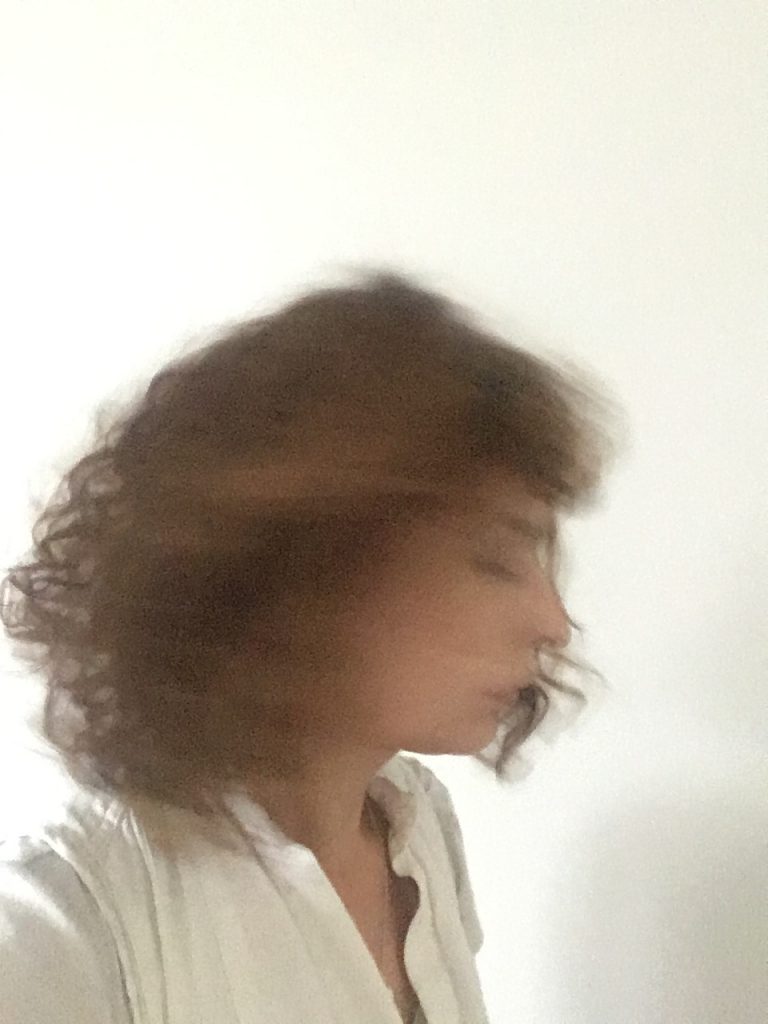
It was exhilarating to feel the heat of the sun and the cool air on my newly bare neck. As each section of hair was cut, and became lighter in weight, up it sprang into its wild ringlets.  When Dad had finished my hair coiled around the level of my chin, and my head was light as a dandelion clock. I stood up tall and shook the clinging tendrils from my clothes, then I shook my head around, relieved of the weight and equally delighted and alarmed at the new shape my shadow made.

Growing up, summer seaside holidays were the only time my hair was left gloriously curlily itself.  For a few weeks, I was free from the enemy of pulling-brushes and combs and the torments of pretty laughing young hairdressers who raked through and tugged at my head every Saturday afternoon. Debbie and Sally, one dark, one blonde, both with no more than a gentle wave to their hair, both young and smiley and beautiful, would stand one either side of me chatting and laughing, and gently teasing me. Lying back at the wash-basin, I was at their giggling mercy as they conducted the ‘eyebrow test’. This was a scientifically rigorous experiment to see whether my dark brows with more than a hint of a monobrow, could stop the water from the shower-tap rushing down my brow and into my eyes. I would laugh too but each time I was desperately hoping for a a fail. “Close your eyes, close your eyes!”, they would say, and I would shut my eyes tight and wait as the warm water tickled down my forehead. “Oh, no, no – it’s a FAIL!”, they would cry, and quickly dab the water from my eyes with a towel. 

I loved the clean smell and softness of shampoo frothing, and the noise and camaraderie. Sometimes the girls, would blow-dry one side of my hair each, racing against each other, one left one right, taming my ringlets with big spiky round brushes. Stuck in the middle, with funny tufts of fluffy hair sticking out of big claw-clips, I was pulled this way and that, wincing, though no-one meant to hurt me. Finally my hair would be smooth and straight, and I would be released to show my mother. “Beautiful,” she would say, “Much better.” and she would hug me, and thank them. 

The rest of the day I could run my fingers through silky-straight waterfalls of hair, so long as it stayed dry. The irony being that once my hair was straightened, water became my enemy. The slightest bit of damp in the air, let alone rain, would be sucked in by my hair, which would fuzz and fluff and frizz as it tried to twist back to its natural state. 

The other enemy of curly hair, is the hair brush. The more you brush it, the messier and less itself, it becomes. Fairytale princesses brushed their hair 100-times before bed to keep it like silk. Sitting at my padded velvet stool and brushing mine, I would watch keenly disappointed, every time as my hair fluffed out and up, less and less like Rapunzel with every stroke. How, I envied that my straight-haired English school-friends could brush their hair and feel it swish and swing behind them like horses tails. 

In the summer though, on holidays by the sea my curly hair was glorious. It would fan out behind me, seaweed in its element as I swam in clear mediterranean water. My sister and I would swim for hours, tumbling and spiralling in the water, swooping down and between each other’s legs to stir up sand or feel along turquoise tiles at the bottom of the pool and pick up a coin or stone we had thrown. One day, three laughing, older dark-limbed Greek boys joined me in the water, splashing and joking and daring me to swim through their legs too and find the coin.

Delighted by the sea and their banter and attention, I accepted the challenge, and they craftily  rose to it too, though I only realised that later, when I was washing the day’s sand and salt off me in the shower. As I soaped my legs and inner thighs clean and felt my skin tingling, and flicked my hair across my back and then I smiled, and I would have blushed, but I was too olive brown for blushing.

The boys threw the coin, and I plunged down, my strong young body, silky hair streaming around as I passed through their parted thighs. Again and again, we brushed against each other, strong and supple catching our breath and diving down so that we were all dizzy and laughing, until tired and needing a break from the saltwater in my eyes, I ran back towards my sister where she was playing in the sand. My sister with her dark straight fringe framing her dimpled face, looked up smiling and carried on digging, as my father came over.

“Who were those boys you were playing with?”, he asked asked. “Just boys,” I said. “Hm”, he said. We stood together, looking out at the sea. He stood close, as we watched the boys still swimming and larking about, throwing each other into the waves. 

My father’s eyes were sea-green in colour. He only had a few dark curls left, cut short behind his ears and at the nape of his neck, the rest of his head, clean and brown and bald. 

Day was turning to evening, and as we stood, watching, the boys ran out and further along the beach grabbed their towels and walked away, to go home, chatting and laughing all the while. One looked back, smiling. 

My dad and I  stood a little longer, and then he looked on as I  paddled and splashed in the shallows with my sister, and my long hair drifted behind me as I moved, and dried in the sun and the breeze, soft and springy thickened with salt, dark and curly.  

daddy’s roast chicken

“You’ve got t’ admit it, Mum, Daddy’s roast chicken is better than yours”, said with a provocative smile, and a little sideways nod of his head.

At that moment, I was lifting a roast chicken, hot out of the oven. The whole house fragrant from its cooking.  Earlier, I had picked fresh thyme and oregano from the heavy terracotta pots I had brought with us from our old garden to this one. I had added the sunshine sharpness of a lemon, a scattering of salt, pepper, and plenty of olive oil.

The gateways of our lives, and so many communal moments in between, are measured out with olive oil. When Greek babies are christened, their naked, lettuce-soft skin is dressed with olive oil. Then they are half-drowned, immersed three-times in the water to be born back into air, thick with incense, screaming out the devil.  Big outraged gulping cries – and as new and slippery as when they first came ashore.

“Hmm” I said. “So, I’ve got’tadmit it, have I? Leg?” as I wrapped the hot ankle bone so he could hold it without burning or getting his fingers greasy.

“Yes, please. Yours is good too.”

In our new, but very old kitchen. The two of us, boy and I, and three cats. The tabby hopeful, sniffing, landed with a definite thump on the work-top. Mewing, she butted my arm with her strong head. I cooled a few strips of breast for her. Put them in the bowl on the side as she pushed my hand away and started chewing steadily. Ginger, nowhere to be seen. Not much interested in real food. Mr Pickles, watching and learning. Not bold enough to make a direct approach.  “Mr Pickles, you too”, as I put a little in his bowl.

My boy was also hovering by my elbow, hungry.

“What does Daddy do to it, then?”

“Not sure, honey, I think” he said, little face peering over his plate – “Ooh, yes!” He said as I put the drumstick on it.

“So how do you roast your chicken,” I asked a few days later, on the phone. “Bean, really likes it. Tells me it’s better than mine”.

Daddy laughed more than necessary. “Honey, er bbq sauce, bit of honey, not sure. Shove it in the oven.” he said. 

“Great, thanks. I’ll try a bit of honey and sauce then.” I said.

Sometimes you’ve got to swallow your pride.

My next weekend, I tried again.

“Is it Daddy’s recipe?”, my boy asked as I lifted the tray, steaming from the oven.

“Yes, Daddy’s roast chicken”, I said, “only, a little bit burnt. That’s the honey”, I said.  

My boy laughed, and said it wasn’t burnt, well, maybe a little, but that’s ok, crispy skin is the best.

Sweet was never an epithet I wanted, or deserved. When he was breaking up with me, and I was trying not to for the sake of our boy, and my own hopes of being a real family, and to hang on to all the good things that I thought we had,  Daddy told his mother I was “sweet”.  Sweet, the simplest of flavours. Soda-pop, unsophisticated, sweet. Neither of us liked sweet. We would forgo pudding for an interesting starter. Hot, earthy, salty, sharp. His mother, Grandma, had reported this to me. “Sweet, me? Really?” Hurt and sickened as I realised that he had turned up his nose and rejected me, (or at least his vague idea of me) entirely, though he camouflaged his disgust and rejection of me as a compliment.

Burnt sugar turns bitter. An attentive cook, knows to catch and cool it at the point before, just where it will add caramel-depth to a plain set-custard. I had finally paid attention to the fact that I had to turn down the heat while sitting on the stairs howling quietly into a tissue again, as Daddy walked away again. Looking up I caught the hurt and confusion on my son’s face echoing back my own.  He touched my arm tentatively, then came close for a cuddle. “It’s ok, Mum” he said. “No it’s not,” I said, “but it will be”.

Now at our new very old house there are, too many empty chairs around our table, so more often than not, just the two of us eat sitting in front of the tv with plates on our laps.

Before at our old house, when we were still together, tea times were the usual kids stuff: table-manners, sausages, chicken, baked beans, strict ketchup rationing.

Daddy’s older boys would complain that the softest chicken breast was “too chewy”. “It’s meat”, I would say. “that’s what teeth are for”, as I gritted mine.

Then one day, they stopped eating sausages. It was just in time for tea. I gritted my teeth tighter than usual, and spooned extra beans.

The food on your plate can be a declaration of love, or of war. Sometimes it’s hard to tell the difference. Either way, tragedy loses any dignity in a mess of beans or gravy 

Later, recounting the story of our tea-time when Daddy had still been at work, I tried-out indignation: “Not halal? But they love sausages. Since when?” 

I muttered something uncharitable about the applicability of Sharia law. Then out louder and with added blasphemy, “Oh, for God’s sake,  So sausages were ok, but now they’re not?”

“Yep,” he said, “Guess so”.

“Fine”, I said, brightly. “…fish fingers”. 

This didn’t have to be our war, but it was difficult to remember that as destabilising shots were fired over our borders. I didn’t intend pork to be a political statement, but that was especially hard being Cypriot and knowing the significance of pork kebab on a menu.

I loved that he cooked for me. Simple tasty things. In hospital, after our boy made his first appearance three-and-a-half weeks early, Daddy turned up appropriately enough. with a bag for life. From it he unpacked china plates, cutlery,  and served a full roast chicken dinner complete with gravy at my hospital bed. While we ate, we stared at our under-baked son: white nappy up to his armpits, little arms and  legs akimbo under warming lights. I don’t remember ever being happier.

Last summer, I went to visit Grandma, at Daddy’s new house for a cuppa after school. “Cake?” She asked.

“Always”, I said. “thanks”, expecting a slightly disappointing supermarket sponge. Instead Grandma brought out two plates carefully unwrapping home-baking paper. “Banana Bread or fruit cake?”

“Oooh, fruit-cake please”, I said. Then between mouthfuls and sipping tea. “So who’s been baking? Two cakes!”

“K [Daddy’s new girlfriend]” Grandma said.

“Hmmmmph” I said, as a drop or two of tea exploded from my mouth. 


pastedGraphic.png


paper birds

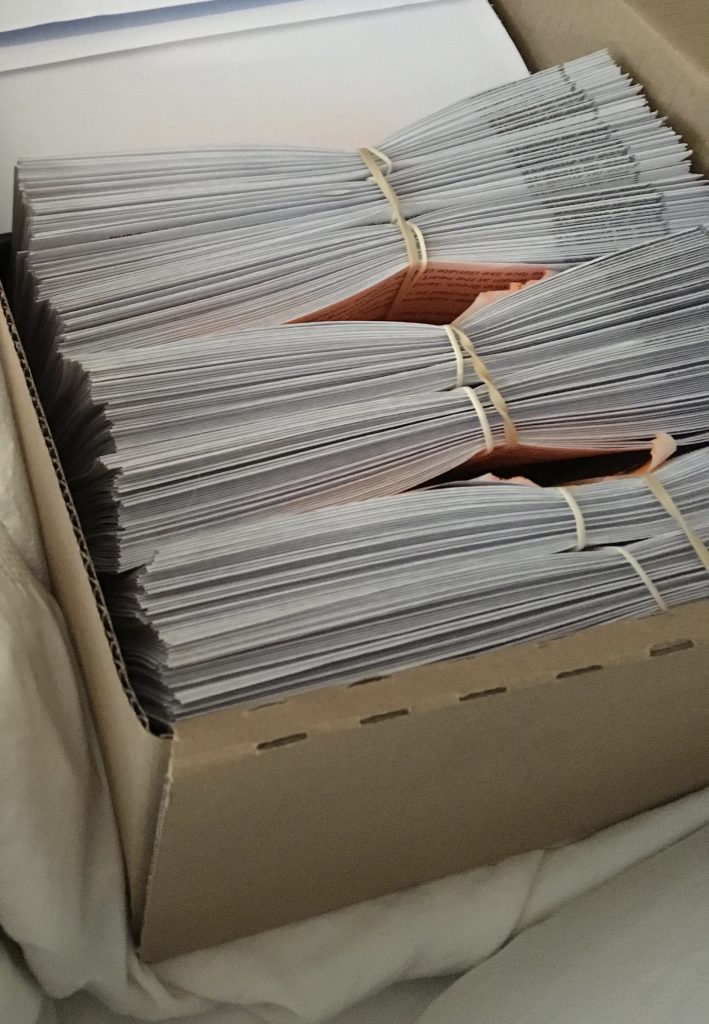
Standing at the doorway smiling, M handed me a cardboard box. Nesting inside were stacks of neatly-folded letters: flocks of origami-birds.

Other hands before mine had folded them, and tied them with bands. Each bundle had a bright orange post-it note with a scribbled code. “They’re ordered by ward and walking-route”, M said. “Best not mix them up”. As if I would. A little calm orderliness felt good in these chaotic times. A little calm ordinariness, cheery, earnest. Leaflets, a cup of strong, builders’ tea and digestive biscuits. Such an English response to the rising waters. Sometimes, I am so terribly English, for a Greek. But then, we share the same patron saint, George, and a dragon’s a dragon, whichever cave you find it in.

Later, I sat on my bed gently pushing the first letters into envelopes that swelled and fluttered in readiness for flight. Their destinations ranged from – sacred to ecclesiastical to secular; St George’s, St Paul’s, Bishopston, Easton, Knowle, and sent me on a map tour of the familiar city in my head. Big green leafy parks, arenas filled with the clattering rush of hard skate wheels on concrete as kids flip and jump and trip over their feet and boards. Hills and traffic and tagging, and unremarkable street after street.

The reason for the box of letters goes back nearly three years to the EU referendum result. Like many I did not sleep well that night, nervously listening to the results coming in on the radio. As the night went on nerves turned to shock, though at the point I dozed off, I was still hopeful that London, stately, scuzzy, pick-n-mix, sugar-rush London, might save the day, in an odd-couple alliance with dour salt-and-water-porridge Scotland.

Instead, I woke on the morning of 24 June 2016 to find that half the country had left the rest of us at home while they embarked on a massive resentment-fuelled bender. None of us knew then how long the hangover would last. It has turned out to be a very long morning after the 70-or so years before. Half the country dressing-up as John Bull in drag every Friday night, chanting meaningless anthems, and drinking themselves silly on imported lager, and gin&tonic before spewing-up bile in the streets. Johnny foreigner looks on with pursed lips and a shake of his head, while the disappointed spouses plot and dream of putting a stop to it all with a mass group intervention.

That morning after, at the gates of my boy’s multi-lingual, multi-coloured school, parents – English, Irish, Hungarian, Algerian, Somalian, West Indian, Polish, American, all of them Bristolian one way or another, were dropping off their children, as usual. Regardless of skin tone, their faces were tighter and paler. A few of us hugged each other but we didn’t have much to say. Disbelief, robbed us of our words, as overnight we found ourselves displaced and disorientated in an unfamiliar new England.

Walking to work after drop off, I did what I do in times of profound crisis: I phoned my dad. “It feels bad, I’ve never felt this was a hostile place before, this is frightening”
“Darling, don’t worry” he said. “It has always been here: English people, they smile at you and are polite. They will come and eat food with you, and be your friend. But really, they think thy are better than you. You are not one of them”, he said.

After work, I went online, and did the other thing I do in times of profound crisis, I bought a kitten from the small-ads. This time from a woman staying with friends and two dogs and three cats in an ex-council flat in Weston-super-Mare. She had just split up, she said. Was looking for a place of her own. She advertised the little tabby as “beautiful part Bengal”. I knew from the photo the mixed-heritage was wishful thinking. But I happily handed over 5 £20 notes, fresh from the cash point, and ignored the white-lie that pushed the price up. I thanked her and drove back home with my new kitten mewing then curling to sleep on the fleece blanket I had bought her in my lunch hour. The estates of Weston were draped with flags of St George hanging limply from bedroom and van windows.

So here we were almost three years later, Minnie, my stout tabby helping me by lounging at the end of the bed and casting a critical eye over my efforts. I tickled her chin and carried on putting euro-election leaflets in envelopes a little more quickly.

Realising half way through that I had not yet read he letter, I unfolded one and the word “Sorry” leapt out. I started to notice the names. In some streets, there was an overabundance of consonants: Grzegorz, Bartlomiej, Agnieszka; In others, an abundance of gods and goddesses: Athena, living on a grey street 10 minutes away. Aphrodite, 20 minutes away. And the spark of recognition, of reaching out, was as bright and warming as a camp fire. And so we carried on, my very own goddess Minnie-Minerva, and I stuffing envelopes. My big high bed, became our arc in the rising waters from where we would send out our fragile little birds.

Minnie chased a few around, hoping to crunch on white-paper bones, then seriously considered sleeping in the box they had come in.

When the waters subside, a bird will come back with a twig in its beak.

e.antoniou 7.6.2019.

snow


It snowed on my birthday.

In the middle of the night, my mother called to my father, “Hurry!”. But their Ford Cortina was covered with a foot of snow. My father, called his nephew S, who was lodging with them,  “Get up, re Malaka…she’s having the baby”, and together they dug out the car.  

S had been thinking ahead about getting to work the next morning and had put a blanket under the car bonnet. Still the engine did not start the first time, or the second. Then the third time as my father sat in the black leather driver’s seat and S pushed the car down the small drive it gave a guttural cough, jumped, and woke up grumbling.  

“Panayia! Mother of God! Hurry!” my mother had cried.

I wasn’t meant to arrive for another month, by when the snow would have long-thawed, and the snowdrops and crocuses would have given way to daffodils. 

“What was I like when I was born?”, I asked as a child, eager to hear the fairytale again.

“Ooh you were tiny, skinny legs and arms, black hair, and these big lips hanging onto your face. When your Bapou saw you, he said to me, ‘what is this? A rabbit?”, my mother would laugh as she said the word rabbit, “kounelli”, and I would laugh too, delighted to be told how I was born ugly but sweet as a Beatrix Potter creature. 

“They had to put the fire out”, my mother would go on with the story. Your Godfather, dear Godfather, S,  forgot to take the blanket off the engine, and we had to stop on the way when it started smoking”. Her golden-brown eyes would narrow and her wide reddened lips stretch with laughing.

This year, it snowed on my birthday. To be precise, it snowed a night and a day before.  It was the most perfect sticky snow. When we realised it was falling, at about 8.45pm, my boy and I abandoned the steam-filled bathroom. Instead we put on our coats and shoes and danced around the front garden in the gathering swirls, sticking out our tongues to catch the flakes. I grabbed the first handful of snow to throw but missed him.  He grabbed a handful from the bonnet of my car and chucked it at me, missing too. I grabbed more and hurled it back where it burst softly as a pillow of white feathers around his face. “YES! direct hit!”, I taunted.

He ducked behind the car, then sneaked behind and scored a cold wet hit to the back of my neck. It was so funny that he had to throw himself onto the cushioned lawn, and roll around dramatically, while shouting, “I slipped, look Mum” as he got up and re-enacted first the snowballing and then the slipping over.

“Inside now – bath!” I said and he ran upstairs excited, pulling off his wet clothes to climb into the bath and warm up. The next morning we made a snowman. Hands burning with cold, and munching at carrots meant for his nose.

My boy came late and early. Three and a half weeks early, 8 days before my 40th birthday.  It had snowed before Christmas as I carried him big-bellied, but still something light in my steps. I trudged to work in the city, when the cars and buses were not getting through. I was wrapped up and booted, a gleeful peasant, delighted at my own strength.  Delighted that my body, had worked perfectly, despite popular opinion, and my sense of guilt and failure, and every feature story for the last 10 years tormenting me:  ‘…egg count … cliff edge’, ‘career’, “miscarriage’, and on and on.

Despite my uncle who stared me in the face at the first family party after my divorce, age 36 and childless, and asked: “And how OLD are you, E?”, And I filled in the inference frozen in the air between us as I refused to answer.  “Now, now H, so rude to ask a lady her age”, I scolded. Inside I was screaming. Too old. Too old.  

Then there was the schoolfriend I could not bear to keep in touch with any more because I was convinced she must have three children by now, and here I was husbandless, childless. When we finally met by chance at the supermarket checkout it turned out she had had 4 rounds of IVF. Unsuccessful. I could hear the avalanche of her pain crashing about me, as she spoke softly and packed bread and milk into carrier bags. 

Walking to work, aged 39, pregnant, I talked to my child constantly at the pace of my walking: “I will carry you little one, always, I will carry you safely…all my life.  Stay in the warm, stay  warm,  grow strong, sweet one.”  My soft endearments casting spells to protect him against the cold hard icy world. 

After the snowball fight, sitting in a bath scented with sandalwood and lavender, water swirled pink and blue from a bath bomb,  my son asked me: “What was I like when I was born?”.  I looked at his pink warm cheeks and glittering eyes and said:

“You were tiny. Skinny little arms and legs, just a scrap of a thing, with a funny pointy head, and beautiful wide lips. When your grandmother saw you, she said to me, what is this? a baby rabbit?”.

e.antoniou

on winter beach

the downs – deal – sky-buoy-sea

My hands look old. Bending down to pick up pebbles, green-blue veins trace like lugworms under the sand of my skin. But I feel as young and excited as a child, breathing in the cold salt air. My feet crunching over pebbles, sinking but solid.  All the while the loud noise of the sea breathing – thunderous drumming and the retreating waves’ deep troubling sigh sucked through teeth.

In the run up to Christmas, we have escaped the stifling warmth in the small cosy room filled with a big TV and our closest family,  to walk on the beach for an hour or so. My boy, his cousin, my brother-in-law, we walk in a rag taggle row, chatting and stooping, and then running down closer to the waves, to throw stones.

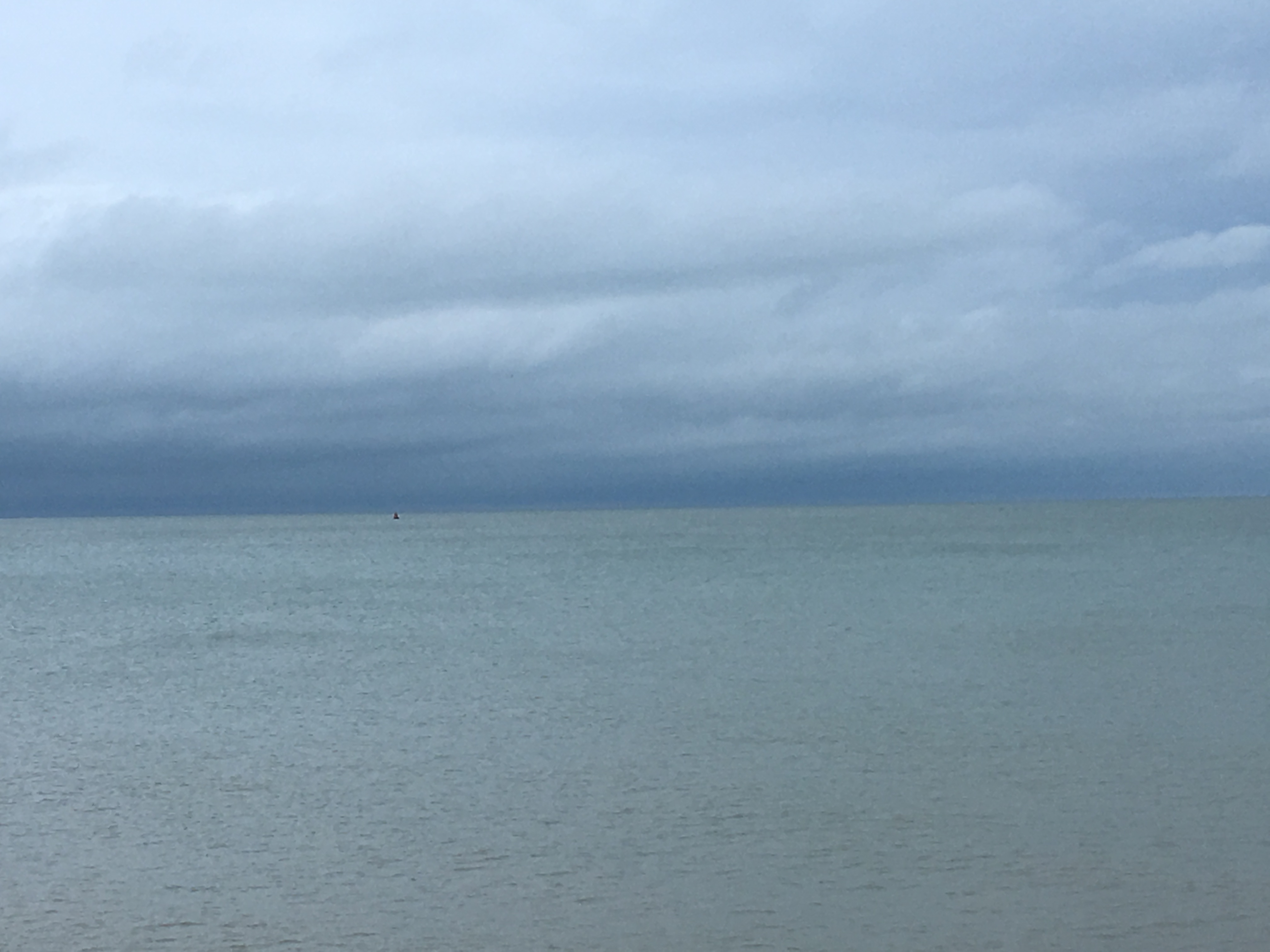
Before we reach the sailing club, and ramshackle working fishing boats, hoisted up on iron chains up the beach, I take a photo of the light-buoy from a patch of the beach where there is nothing more than a line of pebbles, sea and sky. Later I will go and  find the gallery, where I know, I might find and buy a photograph of the same buoy. One of a series, sitting at the point between the literal and abstract. Some of the pictures drenched pure colour, the horizon marked with a pin-prick of red light or the black triangle of the buoy.  Others showing waves, and boats and gulls. Around the coast, northerly, Turner painted his Margate sea-sunsets. Here it is simpler, quieter, more beautiful. I want to stay.

Our  church is in Margate and on Christmas Day I drive there with my Father to sit among some cousins and the incense and icons for an hour or so. In a week or two my Father will walk behind the Greek Orthodox Priest to the shoreline. The Priest will throw  a cross into the sea like a pebble. Dark-olive skinned boys with East Kent accents, will plunge into the cold channel to bring it triumphant to the shore.  A blessing,  carried through the centuries from the deep blue seas of the Aegean, the Mediterranean, the Levantine straights, to this colder place.

My boy runs back and forth to me, filling my pockets with treasure: Big stones, little stones, flinty stones, chalky stones, red stones, black stones, white stones, stones shaped like hearts, stones shaped like penises, whelk shells, cockle shells, seagull feathers.

I find a tangle of anglers’ wire with a lead weight and sharp hook.  It has a yellow and blue tangle that might have been a fly of some sort and it is beautifully weighted and as artfully balanced as a mobile. I want to take it home and suspend it from the ceiling. But the hook is fierce, and knowing my clumsiness, and carrying the terror of motherhood with me always, I know it will end up with the hook in an eye or ungiving wire tangling around the neck of a child.  Worried for the seagulls and beach walkers too, I carry the clear plastic shimmering with the reflection of water and sky, to a bin on the prom where it can do no harm for now.

“See this”, I call to my son, over the wind, pointing to the neat leathery pouch, “mermaids purse”. The sight of its  black tendrils takes me back to the beach further round the coast at Tankerton Slopes, where we swam as children, running down the steep concrete steps from the promenade, then down onto the pebbles, taking off our sandals, “ouch, ouch, ouch” walking firmly on the stones, somehow hurt less than tiptoeing down.  I loved the story of the little mermaid. Ouch ouch…walking, I knew the pain of her first steps. How cruel to make her mute. The small patches of sand revealed at low-tide were a relief to our little feet, and my sister and I would pause there a second or two before splashing into the cold sea with a gasp like the outgoing waves.

The little mermaid, muted by the love of a man, I should have carried my childish indignation  about this into my adult life, but I had a different fairytale in mind. He never actually silenced me, but my words streamed  out in love, and in anger, shouted, spoken, typed into the ether to him, were met with silence. You can roar, sing, whistle all you want into the wind – nothing will come back to you. Nothing will only drive you mad in the end. I have spent long days and nights blinded with rage and pain, naked on edge of the cliffs. In the end, I had to drop over the edge to realise I was on solid ground. Sheepishly, I had picked myself up painted on red lipstick, and got on with work and looking after my boy.

“We can’t take the whole beach, choose a few” I chided my boy, laughing. Reaching to put my hand in my pocket I had suddenly realised that my stealthy mini-mafioso had weighed my coat down with pockets so full of stones that there was no room to warm my hands.  Pockets full of stones, to drown quickly and never float up again. I took out a handful and poured them back onto the beach. Then another but this time, I asked him, which he wanted to keep.

“This one for Nana, and this one for you, and this one and this, and…”. So we threw a few more into the sea towards France, and put a few back in my pockets. The boy and his cousin tumbled together and ran on.  They found a dead seagull, poked at it a bit, then threw a few more stones into the sea, running and laughing, and falling. P and I talking and walking and catching up on the last year or so of our lives.  Then chilled through, we went for hot chocolate with marshmallows at the ice cream parlour, where we were time travellers, looking out at the 1950s pier across blue formica tables.

That night and the next few too, the lifeboats were called out from Walmer, from where we had walked, and across from Dover beach as little rubber dinghies washed up on the beaches. A baby, its mother. Iranian men.   And “far from the Aegean” this same “turbid ebb and flow: Of human misery” flows.

In a few months, this Spring, we are told we must leave the European Union. This little beacon of an island,  will look away from the narrow straight where we were walking on the beach and where so many refugees have washed up one way or another. My car radio will still pick up French radio stations as I drive the long way home to my Greek Cypriot-born family. At this point, when I stand on the beach and see the small tethered buoy on the horizon,  I take joy in my son and his cousin, monkeying about and being children,  but all I can hear is the “melancholy, long withdrawing roar” louder and louder.

(words and picture copyright  e.antoniou January 2019)

Quotes from Matthew Arnold’s On Dover Beach.

red breast

red breast

Home, and at the front door the cats scattered before us. Mr Pickles, still kittenish, quivering hello before running into the hallway tumbling into Minerva, my fat mackerel tabby, and Ginger, skittish nervous ginger. The two girl cats growl and swipe then catching his excitement, follow. 

“Too many cats”, I say. 

“You can’t have too many cats”, my boy says “unless they’re piled to the sky”.

“Ha, that would be too many”.

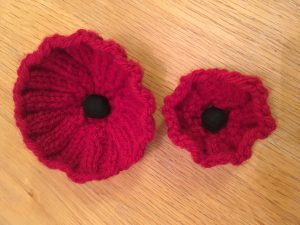
My November poppy is still splashed red on the breast of my coat. All day at work, fragments of the weekend’s Remembrance Sunday singing, half tunes and phrases babble back into my head  – not faded to silence yet: not even after a hundred years. 

Ev-er-y-one suddenly burst out singing: 

And I was filled with such delight 

As prisoned birds must find in freedom,’

Remembrance Sunday – 100 years after the end of the first World War. My boy, L sat smiling at me from the audience as I sang. His flame-haired friend A, sat with him and they swung their legs.

He sat and watched and listened in the chapel. So serious and happy aged 8 nearly 9 and I glimpsed the man in him, sharpening features, his soft soft pale cheeks. I wince to think he will shave one day. And him fresh from his own on-line battle games where the dead re-spawn. ‘bang, bang, bang…’ “Please turn it down a bit”, the noise the constant noise of skirmishes and bravado. It is wonderful and terrifying to be the mother of a boy.

He had sat still and patiently, as well-spoken women read Siegfried Sassoon, of “the choirs. The shrill demented choirs of wailing shells”. I wondered what he made of it all.

After school the next day, as I took off my coat, the air picked up a layer something dark and rolled it along the hallway until it settled in the gap behind a mirror which I had propped up for the time being against the wall. 

The tune flurried and whirled still.

Drifted away…O, but Everyone’…

Bending to unlace my boots, I realised it was not dust, but a drift of downy feathers, curling dark and light as smoke on breath. More feathers further along. The song caught in my throat. “O, but”,

…“wait here a minute”, I said, walking quickly ahead of my boy and following the cats to the kitchen. “How about you watch Cartoon Network”.

But my boy was still following right behind me. My three cats were circling around dark-eyed with excitement. Mr Pickles’ tail all fluffy and his ears pricked up. Always something comical to me about black and white cats. They walk about our ordinary lives fussily overdressed in ill-fitting evening-wear: black coats, white bibs, un-buttoned spats. Suburban Felix-the-cats dancing to Jazz between the wars and into my childhood. 

My very own jazz-time cat was now growling and worrying something in the corner. 

“No, No, get off, Pickles, go’way”. I banged on the table but the thing he had was too exciting for me to scare him off. I pushed his thin strong body away, until I could see what the fuss was about.

The tune still loud in my head, I looked down at rust orange breast feathers. Poppies in the mud. Finely carved beak, and legs and clawed feet curved and as fine as the twining stems of clematis in the garden where he sang this summer.

Little dead star eyes. No breath left. He looked immaculate untouched. 

I thanked Death for being so clean and tidy in my kitchen. 

“Oh Pickles, you horrid cat”, I said putting myself between him and poor dead Robin. The girl cats looked on , sitting back and letting Mr Pickles take the blame. “Away, away”, and I scattered them out, my boy helping me shut them out.

Our heads nearly touched and my boy’s eyes were wide, and serious, as we looked down at the poor dead bird, “Isn’t he beautiful,”, I said, looking at the coloured feathers, his vibrant yellow beak.  “I’m sorry, Mr Robin, I am sorry”.

“Poor bird. But it’s not Pickles’ fault is it. You can’t stop instinct, said my son, who builds homes for insects in the garden. 

“Can you keep the cats away, and I’ll take him outside?”.

“Mum, can we dig a grave for him?”

But I remembering the time I tried to dig a grave in the garden for a fox who had inconsiderately curled up in my flower-bed to die, and even though, robin would take a lot less digging, said, maybe, let me see. I carried the quieted bird outside, wrapped him in a brown paper bag from the recycling box and put him gently and guiltily in the bin, from where the cats could not drag him back out to play again.

Back in the warm, I asked, “Do you know the story of the Robin? How he got his red feathers?”, L shook his head. “He felt sorry for Christ. Tried to pull off his crown of thorns. One pricked his breast and made him bleed.”  

Soon poppies will turn to holly berries. Red splashes.

I had vacuumed the feathers, they were everywhere.

And still the song in my head, on a high cadence rising, throbbing into the air …

Was a bird: and the song was wordless; The singing will never be done.

(c) e.antoniou 2018

poem – everyone sang – siegfried sassoon musical setting by raymond warren.

all hallows

“I am not letting in any more vampires”, I said to J, as he stood at the threshold, smiling and holding sunflowers.

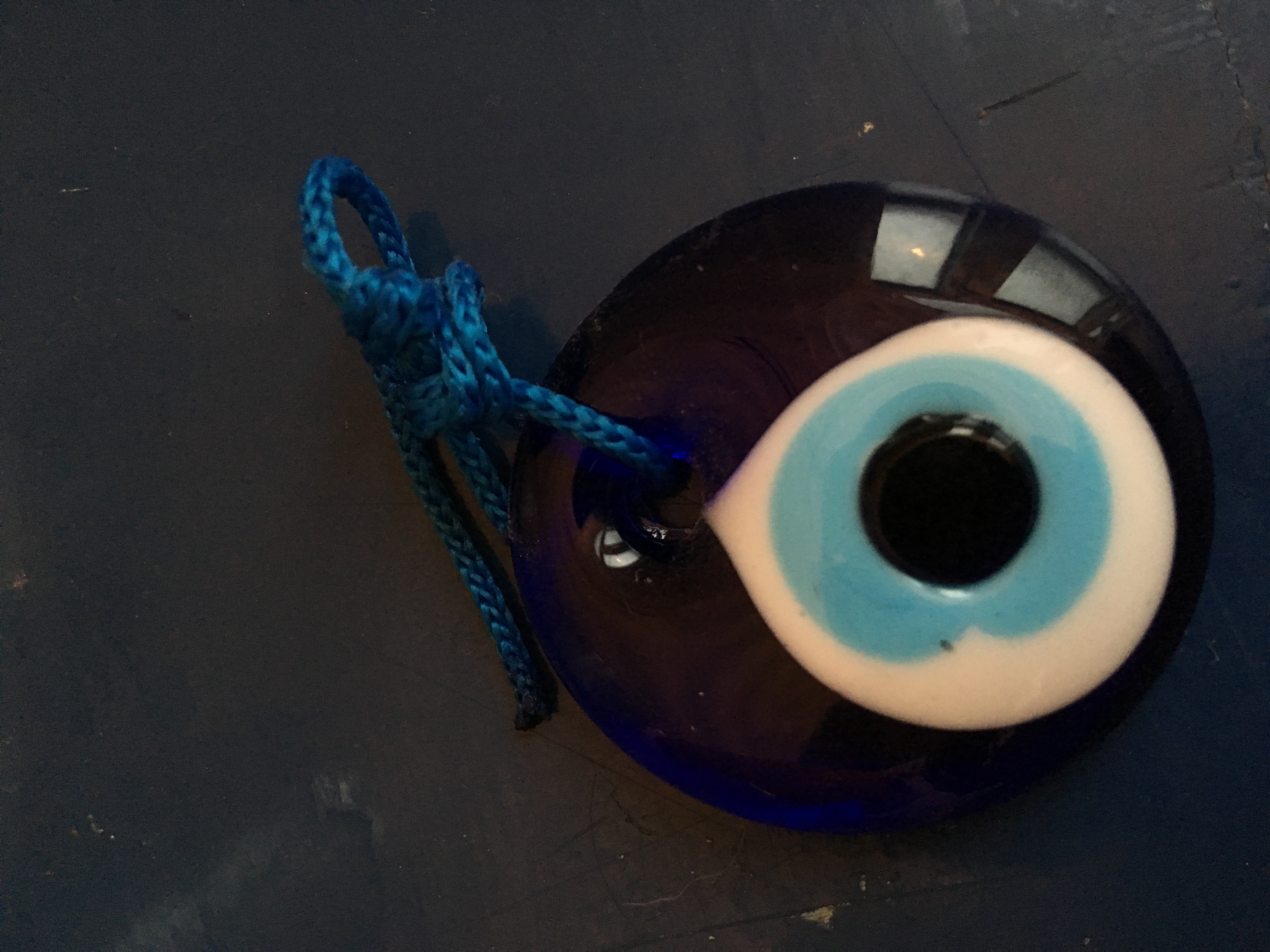
“Ptt, ptt, ptt”, always spit three times on the devil at the doorway, as the Greeks do, “ptt, ptt, ptt, so the evil-eye won’t get you”. Weeks before I had double-looped the glass charm against the evil eye, on a hook on my front door. No more vampires, I had explained to the curious cats rubbing against my legs, darting out of the porch into the sunshine to hunt flies and crawling things.

Now J stood here smiling and holding sunshine. Leaning forwards, I kissed him from the safety of my doorstep then stepped aside. The glass eye-charm shuddered slightly on its blue cord as I closed the door, and shuddering a little too, I took the flowers and another kiss, and laughed.

How do you know a Vampire now that they walk about in daylight? I never was a kick-ass Buffy, but Spike? I fell for that punk every time.

This weekend, the autumn sun was lower in the sky, and the morning air frosted the cars.  J and I went together and bought skeleton lights for around the front door, and an orange pumpkin.   He carried it into the house, the biggest pumpkin we could find, and the three of us, frantic taxidermists, gutted it at the kitchen table, scooping out its slimy entrails.   My boy drew the biggest lantern-jawed, one-toothed laughing face with tadpole eyes and J and he, carved it back to life, the spirit of All Hallows Eve, as the smell of sausages and sweet slow-cooking onion filled the kitchen.

My greek-eye charm draped around with rubber bats, watching swarms of very short vampires and zombies crowding in at the porch. Skinny arms and grasping hands reaching for the big bowl of sweets.  We let them in as far as the porch but only my very own caped pumpkin-headed boy was allowed past the threshold. The ghosts and ghouls all said thank you and moved on, willow the wisps, to the next lighted doorway.

“Mummy, they’re going, Mum..they’re going without us”.  Me and my boy. Cross with me for hanging back, wanting to run and catch up with O. his friend from next door. Not knowing the other ghouls in his group. A new crowd. Pulling at his cape, his mask, cross that he nearly tripped over.  Cross that he can’t see clearly as the ghastly pumpkin mask slips over his radiant face.  Holding my hand tight. Too far behind, missing out a house or two to catch up. Cross at being left behind, outside the laughing crowd. I hold his hand tight and pull him close. “We’ll catch up, sweet,”.  I put his cloak right, smooth the tears away, straighten his mask.  “Go, on – O’s there,” and he is gone, running up the path. My hand falling to my side, colder. Soon as loud and fast as the rest of them.  Our first trick-or-treating on our road. Claiming the neighbourhood, and his new friendships, with shrieks and chatter and too much sugar.  Children playing with death. Excited. So alive.

e.antoniou 2018

one foot in front of the other

Thick-soled boots. Thick socks. Thin black lycra onion-layered. My outfit about 1/8th Ninja, 1/8th granny-on-a-hike. Even on Gloucester Road, where you could wear a cat on your head and no-one look twice, I swear I had a few second-glances.  

“Well you do have quite a neat little figure”, said J – ever the gentleman, as we walked to meet L, after breakfast of soft-poached eggs, fried mushrooms, chewy buttered-toast, and coffee.

“They were looking at my socks and boots, not my arse”, I said, “anyway, you’re biased”.  

He dropped us off, and in the town square there were loud drums and loud bright people to send us off. L grimaced.  I grimaced back. We had both pulled our lycra vest tops down as far as they would stretch to cover our bums.  

We walked quickly through the small crowd, and made ourselves a little smaller as we passed the open-air stage.  

Sometimes all you want is ordinary.

Registering, our names ticked off by smiling women who weighed down their papers with water bottles as the strong gusting wind grabbed at them. Then hanging back a little, we joined the walk.

We smiled and said thank you every little while to the stewards, who stood patiently and pointed the way as the rain dripped down them, and we trailed by.  A long thin line, following the tow-path out of the city. Ahead of us a father with his two children, and an eager dog sniffing the air and pulling at the lead. Quite a few fathers walking alone with their children.  Older couples.  Small groups of friends.

All wearing purple t-shirts with the slogans,  ‘Let’s walk together’. And, ‘Living Well with Cancer’.  

After her diagnosis, L’s husband had run a marathon for her. 

Mine left me. Trapped a while by my illness, he came back to sit next to me, white-faced as my plastic surgeon told me, how he would “Scoop it out” and then gently measured my pound of flesh for reconstruction.

We talked through treatment options, and in the day-time he would sometimes hold my hand to steady me along over-bright hospital corridors as I stumbled on.  But my love, father-of-my-child, was a ghost to me. At night he haunted our house staying for our boy, sweet two-and-a-half. I would listen to daddy’s expressionless voice reading bed-time stories, as I lay in my room.  Then he would tuck him in smothering his baby-face with kisses, and walk quietly past my door, up the next flight of stairs, hand stroking the mahogany bannister, to his own bed in the attic.  I would lie listening out, sleepless. Untouched, un-held in the darkness. Breathless with fear and loss.

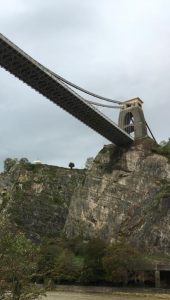
L and I found a steady rhythm to our walking.  And we didn’t stop talking, not for a minute. Chatter shimmering in the air between us as the grey light over the muddy water. Past the floating harbour. Past an ex-lover’s red-painted boat. A Banksy mural. Stopping to take a photo smiling broadly, with the suspension bridge, towering above us. Walking with the water beside us – always a promise of wider seas.

My face open to the warm wind and rain. Warm perfumed pricklings of sweat in the gulley of my chest bone between my old breast and my new one. We walked together, two friends, talking about everyday things. Our mouths moving as much as our legs. Ordinary. Little bits of gossip. Children, school, dancing, kisses, house plans, ours and other people’s. One foot in front of the other for seven miles of our lives. Strong and well, and chatting.

We have both come a long way. Some of it together, and some of it beautifully ordinary.


Home