Brexit

paper birds

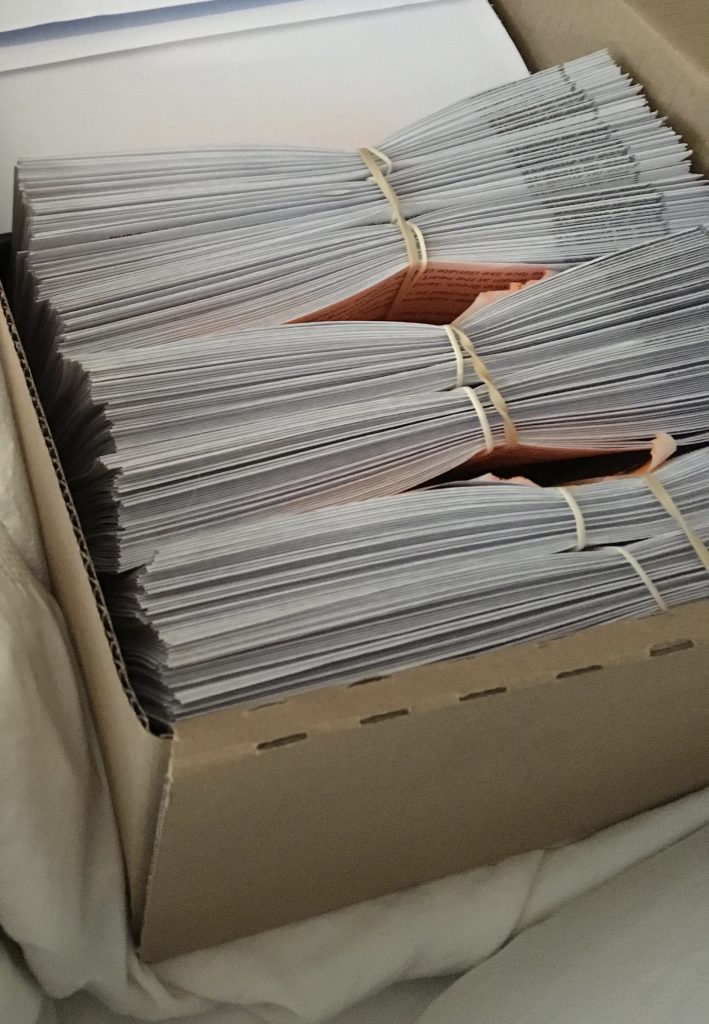
Standing at the doorway smiling, M handed me a cardboard box. Nesting inside were stacks of neatly-folded letters: flocks of origami-birds.

Other hands before mine had folded them, and tied them with bands. Each bundle had a bright orange post-it note with a scribbled code. “They’re ordered by ward and walking-route”, M said. “Best not mix them up”. As if I would. A little calm orderliness felt good in these chaotic times. A little calm ordinariness, cheery, earnest. Leaflets, a cup of strong, builders’ tea and digestive biscuits. Such an English response to the rising waters. Sometimes, I am so terribly English, for a Greek. But then, we share the same patron saint, George, and a dragon’s a dragon, whichever cave you find it in.

Later, I sat on my bed gently pushing the first letters into envelopes that swelled and fluttered in readiness for flight. Their destinations ranged from – sacred to ecclesiastical to secular; St George’s, St Paul’s, Bishopston, Easton, Knowle, and sent me on a map tour of the familiar city in my head. Big green leafy parks, arenas filled with the clattering rush of hard skate wheels on concrete as kids flip and jump and trip over their feet and boards. Hills and traffic and tagging, and unremarkable street after street.

The reason for the box of letters goes back nearly three years to the EU referendum result. Like many I did not sleep well that night, nervously listening to the results coming in on the radio. As the night went on nerves turned to shock, though at the point I dozed off, I was still hopeful that London, stately, scuzzy, pick-n-mix, sugar-rush London, might save the day, in an odd-couple alliance with dour salt-and-water-porridge Scotland.

Instead, I woke on the morning of 24 June 2016 to find that half the country had left the rest of us at home while they embarked on a massive resentment-fuelled bender. None of us knew then how long the hangover would last. It has turned out to be a very long morning after the 70-or so years before. Half the country dressing-up as John Bull in drag every Friday night, chanting meaningless anthems, and drinking themselves silly on imported lager, and gin&tonic before spewing-up bile in the streets. Johnny foreigner looks on with pursed lips and a shake of his head, while the disappointed spouses plot and dream of putting a stop to it all with a mass group intervention.

That morning after, at the gates of my boy’s multi-lingual, multi-coloured school, parents – English, Irish, Hungarian, Algerian, Somalian, West Indian, Polish, American, all of them Bristolian one way or another, were dropping off their children, as usual. Regardless of skin tone, their faces were tighter and paler. A few of us hugged each other but we didn’t have much to say. Disbelief, robbed us of our words, as overnight we found ourselves displaced and disorientated in an unfamiliar new England.

Walking to work after drop off, I did what I do in times of profound crisis: I phoned my dad. “It feels bad, I’ve never felt this was a hostile place before, this is frightening”
“Darling, don’t worry” he said. “It has always been here: English people, they smile at you and are polite. They will come and eat food with you, and be your friend. But really, they think thy are better than you. You are not one of them”, he said.

After work, I went online, and did the other thing I do in times of profound crisis, I bought a kitten from the small-ads. This time from a woman staying with friends and two dogs and three cats in an ex-council flat in Weston-super-Mare. She had just split up, she said. Was looking for a place of her own. She advertised the little tabby as “beautiful part Bengal”. I knew from the photo the mixed-heritage was wishful thinking. But I happily handed over 5 £20 notes, fresh from the cash point, and ignored the white-lie that pushed the price up. I thanked her and drove back home with my new kitten mewing then curling to sleep on the fleece blanket I had bought her in my lunch hour. The estates of Weston were draped with flags of St George hanging limply from bedroom and van windows.

So here we were almost three years later, Minnie, my stout tabby helping me by lounging at the end of the bed and casting a critical eye over my efforts. I tickled her chin and carried on putting euro-election leaflets in envelopes a little more quickly.

Realising half way through that I had not yet read he letter, I unfolded one and the word “Sorry” leapt out. I started to notice the names. In some streets, there was an overabundance of consonants: Grzegorz, Bartlomiej, Agnieszka; In others, an abundance of gods and goddesses: Athena, living on a grey street 10 minutes away. Aphrodite, 20 minutes away. And the spark of recognition, of reaching out, was as bright and warming as a camp fire. And so we carried on, my very own goddess Minnie-Minerva, and I stuffing envelopes. My big high bed, became our arc in the rising waters from where we would send out our fragile little birds.

Minnie chased a few around, hoping to crunch on white-paper bones, then seriously considered sleeping in the box they had come in.

When the waters subside, a bird will come back with a twig in its beak.

e.antoniou 7.6.2019.
on winter beach

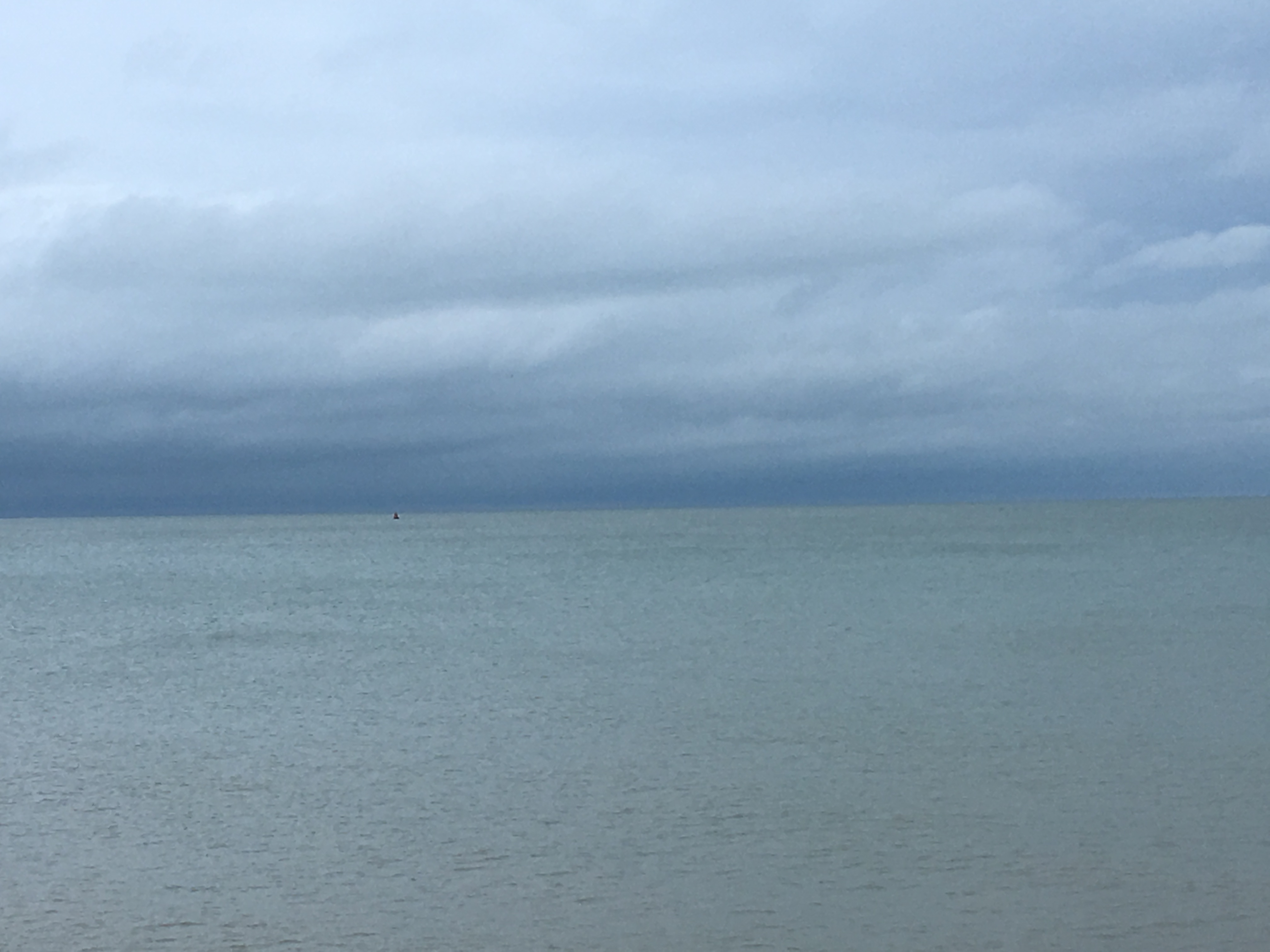
the downs – deal – sky-buoy-sea

My hands look old. Bending down to pick up pebbles, green-blue veins trace like lugworms under the sand of my skin. But I feel as young and excited as a child, breathing in the cold salt air. My feet crunching over pebbles, sinking but solid.  All the while the loud noise of the sea breathing – thunderous drumming and the retreating waves’ deep troubling sigh sucked through teeth.

In the run up to Christmas, we have escaped the stifling warmth in the small cosy room filled with a big TV and our closest family,  to walk on the beach for an hour or so. My boy, his cousin, my brother-in-law, we walk in a rag taggle row, chatting and stooping, and then running down closer to the waves, to throw stones.

Before we reach the sailing club, and ramshackle working fishing boats, hoisted up on iron chains up the beach, I take a photo of the light-buoy from a patch of the beach where there is nothing more than a line of pebbles, sea and sky. Later I will go and  find the gallery, where I know, I might find and buy a photograph of the same buoy. One of a series, sitting at the point between the literal and abstract. Some of the pictures drenched pure colour, the horizon marked with a pin-prick of red light or the black triangle of the buoy.  Others showing waves, and boats and gulls. Around the coast, northerly, Turner painted his Margate sea-sunsets. Here it is simpler, quieter, more beautiful. I want to stay.

Our  church is in Margate and on Christmas Day I drive there with my Father to sit among some cousins and the incense and icons for an hour or so. In a week or two my Father will walk behind the Greek Orthodox Priest to the shoreline. The Priest will throw  a cross into the sea like a pebble. Dark-olive skinned boys with East Kent accents, will plunge into the cold channel to bring it triumphant to the shore.  A blessing,  carried through the centuries from the deep blue seas of the Aegean, the Mediterranean, the Levantine straights, to this colder place.

My boy runs back and forth to me, filling my pockets with treasure: Big stones, little stones, flinty stones, chalky stones, red stones, black stones, white stones, stones shaped like hearts, stones shaped like penises, whelk shells, cockle shells, seagull feathers.

I find a tangle of anglers’ wire with a lead weight and sharp hook.  It has a yellow and blue tangle that might have been a fly of some sort and it is beautifully weighted and as artfully balanced as a mobile. I want to take it home and suspend it from the ceiling. But the hook is fierce, and knowing my clumsiness, and carrying the terror of motherhood with me always, I know it will end up with the hook in an eye or ungiving wire tangling around the neck of a child.  Worried for the seagulls and beach walkers too, I carry the clear plastic shimmering with the reflection of water and sky, to a bin on the prom where it can do no harm for now.

“See this”, I call to my son, over the wind, pointing to the neat leathery pouch, “mermaids purse”. The sight of its  black tendrils takes me back to the beach further round the coast at Tankerton Slopes, where we swam as children, running down the steep concrete steps from the promenade, then down onto the pebbles, taking off our sandals, “ouch, ouch, ouch” walking firmly on the stones, somehow hurt less than tiptoeing down.  I loved the story of the little mermaid. Ouch ouch…walking, I knew the pain of her first steps. How cruel to make her mute. The small patches of sand revealed at low-tide were a relief to our little feet, and my sister and I would pause there a second or two before splashing into the cold sea with a gasp like the outgoing waves.

The little mermaid, muted by the love of a man, I should have carried my childish indignation  about this into my adult life, but I had a different fairytale in mind. He never actually silenced me, but my words streamed  out in love, and in anger, shouted, spoken, typed into the ether to him, were met with silence. You can roar, sing, whistle all you want into the wind – nothing will come back to you. Nothing will only drive you mad in the end. I have spent long days and nights blinded with rage and pain, naked on edge of the cliffs. In the end, I had to drop over the edge to realise I was on solid ground. Sheepishly, I had picked myself up painted on red lipstick, and got on with work and looking after my boy.

“We can’t take the whole beach, choose a few” I chided my boy, laughing. Reaching to put my hand in my pocket I had suddenly realised that my stealthy mini-mafioso had weighed my coat down with pockets so full of stones that there was no room to warm my hands.  Pockets full of stones, to drown quickly and never float up again. I took out a handful and poured them back onto the beach. Then another but this time, I asked him, which he wanted to keep.

“This one for Nana, and this one for you, and this one and this, and…”. So we threw a few more into the sea towards France, and put a few back in my pockets. The boy and his cousin tumbled together and ran on.  They found a dead seagull, poked at it a bit, then threw a few more stones into the sea, running and laughing, and falling. P and I talking and walking and catching up on the last year or so of our lives.  Then chilled through, we went for hot chocolate with marshmallows at the ice cream parlour, where we were time travellers, looking out at the 1950s pier across blue formica tables.

That night and the next few too, the lifeboats were called out from Walmer, from where we had walked, and across from Dover beach as little rubber dinghies washed up on the beaches. A baby, its mother. Iranian men.   And “far from the Aegean” this same “turbid ebb and flow: Of human misery” flows.

In a few months, this Spring, we are told we must leave the European Union. This little beacon of an island,  will look away from the narrow straight where we were walking on the beach and where so many refugees have washed up one way or another. My car radio will still pick up French radio stations as I drive the long way home to my Greek Cypriot-born family. At this point, when I stand on the beach and see the small tethered buoy on the horizon,  I take joy in my son and his cousin, monkeying about and being children,  but all I can hear is the “melancholy, long withdrawing roar” louder and louder.

(words and picture copyright  e.antoniou January 2019)

Quotes from Matthew Arnold’s On Dover Beach.