divorce

daddy’s roast chicken

“You’ve got t’ admit it, Mum, Daddy’s roast chicken is better than yours”, said with a provocative smile, and a little sideways nod of his head.

At that moment, I was lifting a roast chicken, hot out of the oven. The whole house fragrant from its cooking.  Earlier, I had picked fresh thyme and oregano from the heavy terracotta pots I had brought with us from our old garden to this one. I had added the sunshine sharpness of a lemon, a scattering of salt, pepper, and plenty of olive oil.

The gateways of our lives, and so many communal moments in between, are measured out with olive oil. When Greek babies are christened, their naked, lettuce-soft skin is dressed with olive oil. Then they are half-drowned, immersed three-times in the water to be born back into air, thick with incense, screaming out the devil.  Big outraged gulping cries – and as new and slippery as when they first came ashore.

“Hmm” I said. “So, I’ve got’tadmit it, have I? Leg?” as I wrapped the hot ankle bone so he could hold it without burning or getting his fingers greasy.

“Yes, please. Yours is good too.”

In our new, but very old kitchen. The two of us, boy and I, and three cats. The tabby hopeful, sniffing, landed with a definite thump on the work-top. Mewing, she butted my arm with her strong head. I cooled a few strips of breast for her. Put them in the bowl on the side as she pushed my hand away and started chewing steadily. Ginger, nowhere to be seen. Not much interested in real food. Mr Pickles, watching and learning. Not bold enough to make a direct approach.  “Mr Pickles, you too”, as I put a little in his bowl.

My boy was also hovering by my elbow, hungry.

“What does Daddy do to it, then?”

“Not sure, honey, I think” he said, little face peering over his plate – “Ooh, yes!” He said as I put the drumstick on it.

“So how do you roast your chicken,” I asked a few days later, on the phone. “Bean, really likes it. Tells me it’s better than mine”.

Daddy laughed more than necessary. “Honey, er bbq sauce, bit of honey, not sure. Shove it in the oven.” he said. 

“Great, thanks. I’ll try a bit of honey and sauce then.” I said.

Sometimes you’ve got to swallow your pride.

My next weekend, I tried again.

“Is it Daddy’s recipe?”, my boy asked as I lifted the tray, steaming from the oven.

“Yes, Daddy’s roast chicken”, I said, “only, a little bit burnt. That’s the honey”, I said.  

My boy laughed, and said it wasn’t burnt, well, maybe a little, but that’s ok, crispy skin is the best.

Sweet was never an epithet I wanted, or deserved. When he was breaking up with me, and I was trying not to for the sake of our boy, and my own hopes of being a real family, and to hang on to all the good things that I thought we had,  Daddy told his mother I was “sweet”.  Sweet, the simplest of flavours. Soda-pop, unsophisticated, sweet. Neither of us liked sweet. We would forgo pudding for an interesting starter. Hot, earthy, salty, sharp. His mother, Grandma, had reported this to me. “Sweet, me? Really?” Hurt and sickened as I realised that he had turned up his nose and rejected me, (or at least his vague idea of me) entirely, though he camouflaged his disgust and rejection of me as a compliment.

Burnt sugar turns bitter. An attentive cook, knows to catch and cool it at the point before, just where it will add caramel-depth to a plain set-custard. I had finally paid attention to the fact that I had to turn down the heat while sitting on the stairs howling quietly into a tissue again, as Daddy walked away again. Looking up I caught the hurt and confusion on my son’s face echoing back my own.  He touched my arm tentatively, then came close for a cuddle. “It’s ok, Mum” he said. “No it’s not,” I said, “but it will be”.

Now at our new very old house there are, too many empty chairs around our table, so more often than not, just the two of us eat sitting in front of the tv with plates on our laps.

Before at our old house, when we were still together, tea times were the usual kids stuff: table-manners, sausages, chicken, baked beans, strict ketchup rationing.

Daddy’s older boys would complain that the softest chicken breast was “too chewy”. “It’s meat”, I would say. “that’s what teeth are for”, as I gritted mine.

Then one day, they stopped eating sausages. It was just in time for tea. I gritted my teeth tighter than usual, and spooned extra beans.

The food on your plate can be a declaration of love, or of war. Sometimes it’s hard to tell the difference. Either way, tragedy loses any dignity in a mess of beans or gravy 

Later, recounting the story of our tea-time when Daddy had still been at work, I tried-out indignation: “Not halal? But they love sausages. Since when?” 

I muttered something uncharitable about the applicability of Sharia law. Then out louder and with added blasphemy, “Oh, for God’s sake,  So sausages were ok, but now they’re not?”

“Yep,” he said, “Guess so”.

“Fine”, I said, brightly. “…fish fingers”. 

This didn’t have to be our war, but it was difficult to remember that as destabilising shots were fired over our borders. I didn’t intend pork to be a political statement, but that was especially hard being Cypriot and knowing the significance of pork kebab on a menu.

I loved that he cooked for me. Simple tasty things. In hospital, after our boy made his first appearance three-and-a-half weeks early, Daddy turned up appropriately enough. with a bag for life. From it he unpacked china plates, cutlery,  and served a full roast chicken dinner complete with gravy at my hospital bed. While we ate, we stared at our under-baked son: white nappy up to his armpits, little arms and  legs akimbo under warming lights. I don’t remember ever being happier.

Last summer, I went to visit Grandma, at Daddy’s new house for a cuppa after school. “Cake?” She asked.

“Always”, I said. “thanks”, expecting a slightly disappointing supermarket sponge. Instead Grandma brought out two plates carefully unwrapping home-baking paper. “Banana Bread or fruit cake?”

“Oooh, fruit-cake please”, I said. Then between mouthfuls and sipping tea. “So who’s been baking? Two cakes!”

“K [Daddy’s new girlfriend]” Grandma said.

“Hmmmmph” I said, as a drop or two of tea exploded from my mouth. 


pastedGraphic.png


on winter beach

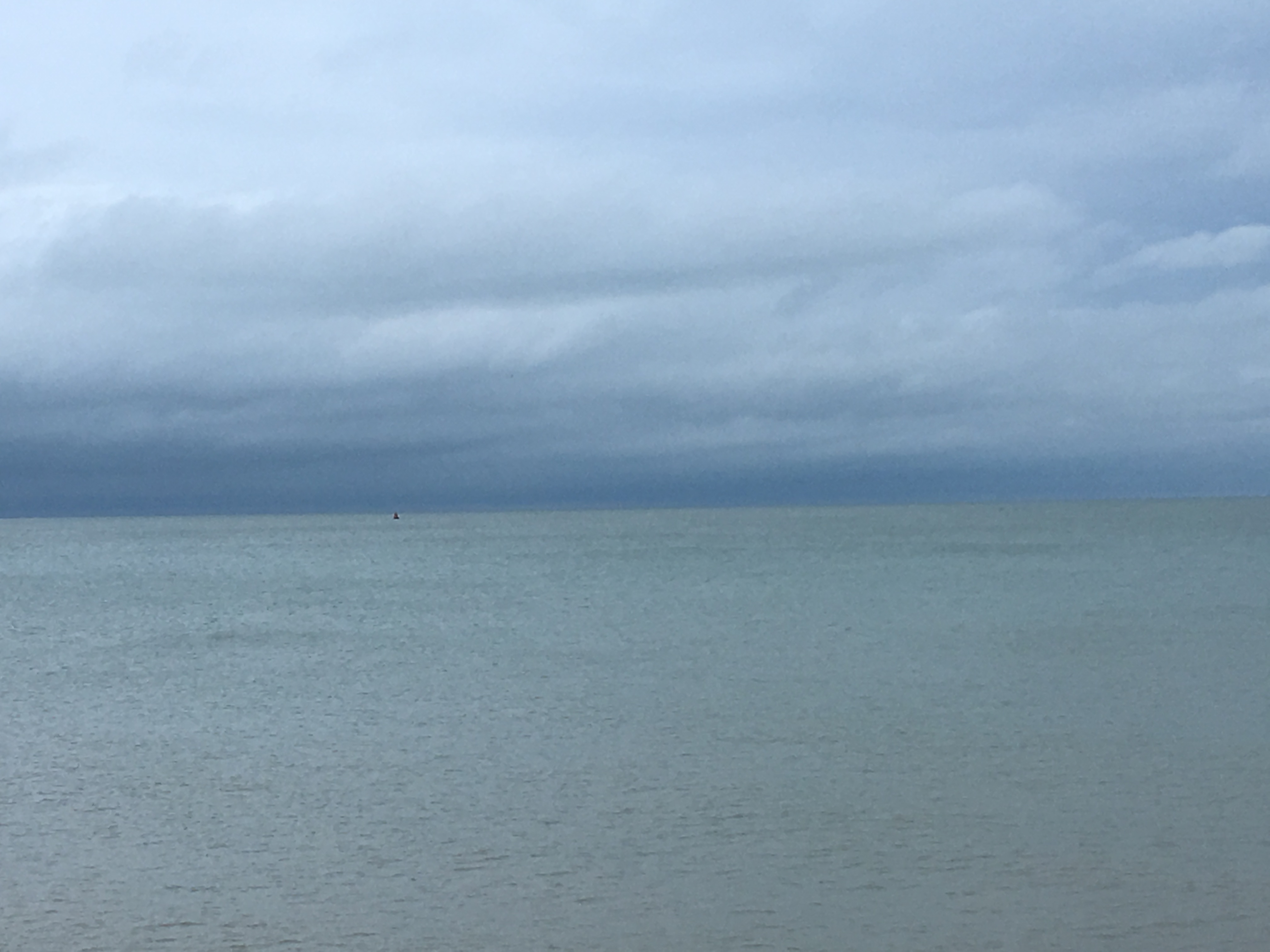
the downs – deal – sky-buoy-sea

My hands look old. Bending down to pick up pebbles, green-blue veins trace like lugworms under the sand of my skin. But I feel as young and excited as a child, breathing in the cold salt air. My feet crunching over pebbles, sinking but solid.  All the while the loud noise of the sea breathing – thunderous drumming and the retreating waves’ deep troubling sigh sucked through teeth.

In the run up to Christmas, we have escaped the stifling warmth in the small cosy room filled with a big TV and our closest family,  to walk on the beach for an hour or so. My boy, his cousin, my brother-in-law, we walk in a rag taggle row, chatting and stooping, and then running down closer to the waves, to throw stones.

Before we reach the sailing club, and ramshackle working fishing boats, hoisted up on iron chains up the beach, I take a photo of the light-buoy from a patch of the beach where there is nothing more than a line of pebbles, sea and sky. Later I will go and  find the gallery, where I know, I might find and buy a photograph of the same buoy. One of a series, sitting at the point between the literal and abstract. Some of the pictures drenched pure colour, the horizon marked with a pin-prick of red light or the black triangle of the buoy.  Others showing waves, and boats and gulls. Around the coast, northerly, Turner painted his Margate sea-sunsets. Here it is simpler, quieter, more beautiful. I want to stay.

Our  church is in Margate and on Christmas Day I drive there with my Father to sit among some cousins and the incense and icons for an hour or so. In a week or two my Father will walk behind the Greek Orthodox Priest to the shoreline. The Priest will throw  a cross into the sea like a pebble. Dark-olive skinned boys with East Kent accents, will plunge into the cold channel to bring it triumphant to the shore.  A blessing,  carried through the centuries from the deep blue seas of the Aegean, the Mediterranean, the Levantine straights, to this colder place.

My boy runs back and forth to me, filling my pockets with treasure: Big stones, little stones, flinty stones, chalky stones, red stones, black stones, white stones, stones shaped like hearts, stones shaped like penises, whelk shells, cockle shells, seagull feathers.

I find a tangle of anglers’ wire with a lead weight and sharp hook.  It has a yellow and blue tangle that might have been a fly of some sort and it is beautifully weighted and as artfully balanced as a mobile. I want to take it home and suspend it from the ceiling. But the hook is fierce, and knowing my clumsiness, and carrying the terror of motherhood with me always, I know it will end up with the hook in an eye or ungiving wire tangling around the neck of a child.  Worried for the seagulls and beach walkers too, I carry the clear plastic shimmering with the reflection of water and sky, to a bin on the prom where it can do no harm for now.

“See this”, I call to my son, over the wind, pointing to the neat leathery pouch, “mermaids purse”. The sight of its  black tendrils takes me back to the beach further round the coast at Tankerton Slopes, where we swam as children, running down the steep concrete steps from the promenade, then down onto the pebbles, taking off our sandals, “ouch, ouch, ouch” walking firmly on the stones, somehow hurt less than tiptoeing down.  I loved the story of the little mermaid. Ouch ouch…walking, I knew the pain of her first steps. How cruel to make her mute. The small patches of sand revealed at low-tide were a relief to our little feet, and my sister and I would pause there a second or two before splashing into the cold sea with a gasp like the outgoing waves.

The little mermaid, muted by the love of a man, I should have carried my childish indignation  about this into my adult life, but I had a different fairytale in mind. He never actually silenced me, but my words streamed  out in love, and in anger, shouted, spoken, typed into the ether to him, were met with silence. You can roar, sing, whistle all you want into the wind – nothing will come back to you. Nothing will only drive you mad in the end. I have spent long days and nights blinded with rage and pain, naked on edge of the cliffs. In the end, I had to drop over the edge to realise I was on solid ground. Sheepishly, I had picked myself up painted on red lipstick, and got on with work and looking after my boy.

“We can’t take the whole beach, choose a few” I chided my boy, laughing. Reaching to put my hand in my pocket I had suddenly realised that my stealthy mini-mafioso had weighed my coat down with pockets so full of stones that there was no room to warm my hands.  Pockets full of stones, to drown quickly and never float up again. I took out a handful and poured them back onto the beach. Then another but this time, I asked him, which he wanted to keep.

“This one for Nana, and this one for you, and this one and this, and…”. So we threw a few more into the sea towards France, and put a few back in my pockets. The boy and his cousin tumbled together and ran on.  They found a dead seagull, poked at it a bit, then threw a few more stones into the sea, running and laughing, and falling. P and I talking and walking and catching up on the last year or so of our lives.  Then chilled through, we went for hot chocolate with marshmallows at the ice cream parlour, where we were time travellers, looking out at the 1950s pier across blue formica tables.

That night and the next few too, the lifeboats were called out from Walmer, from where we had walked, and across from Dover beach as little rubber dinghies washed up on the beaches. A baby, its mother. Iranian men.   And “far from the Aegean” this same “turbid ebb and flow: Of human misery” flows.

In a few months, this Spring, we are told we must leave the European Union. This little beacon of an island,  will look away from the narrow straight where we were walking on the beach and where so many refugees have washed up one way or another. My car radio will still pick up French radio stations as I drive the long way home to my Greek Cypriot-born family. At this point, when I stand on the beach and see the small tethered buoy on the horizon,  I take joy in my son and his cousin, monkeying about and being children,  but all I can hear is the “melancholy, long withdrawing roar” louder and louder.

(words and picture copyright  e.antoniou January 2019)

Quotes from Matthew Arnold’s On Dover Beach.

all hallows

“I am not letting in any more vampires”, I said to J, as he stood at the threshold, smiling and holding sunflowers.

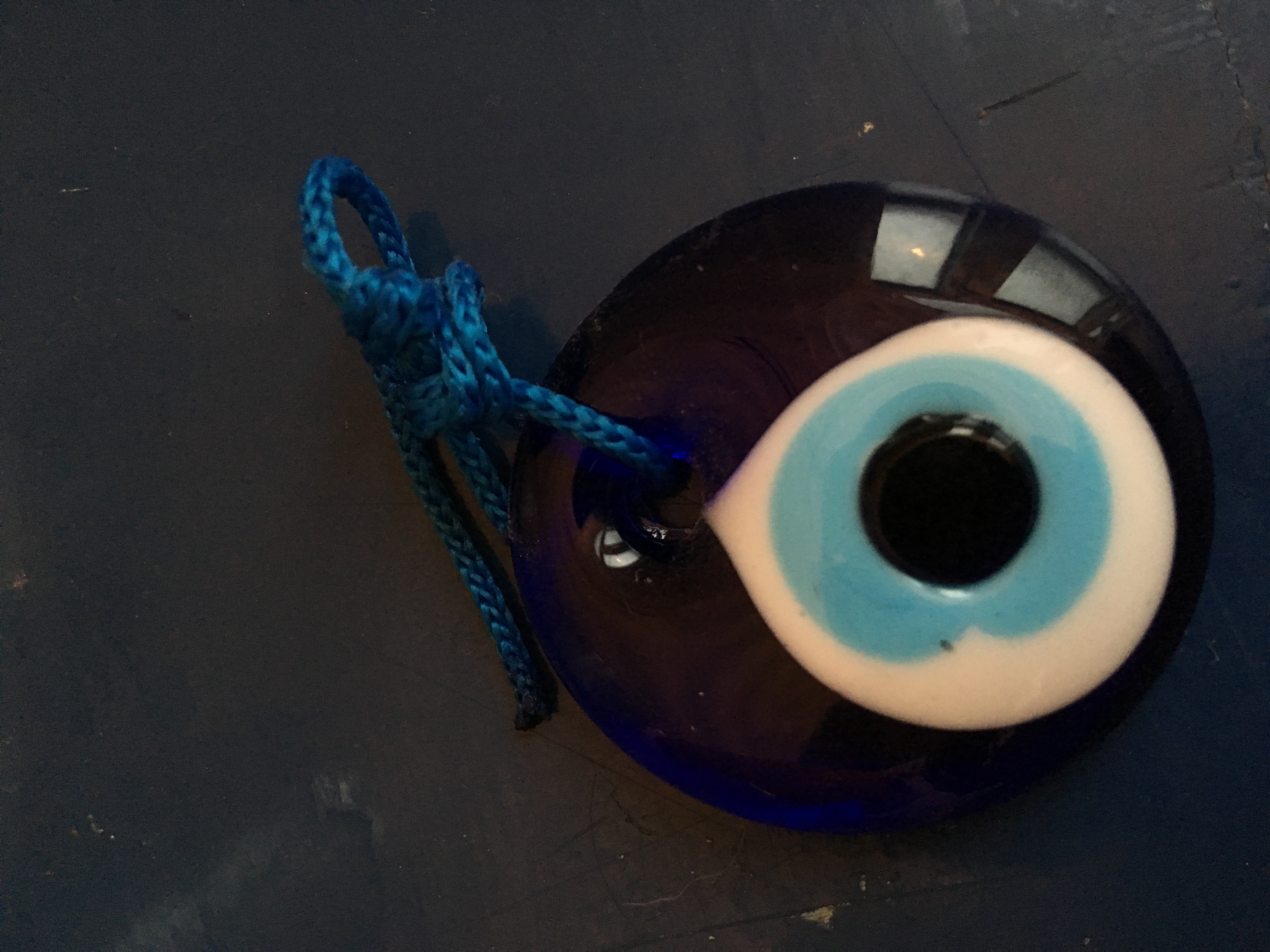
“Ptt, ptt, ptt”, always spit three times on the devil at the doorway, as the Greeks do, “ptt, ptt, ptt, so the evil-eye won’t get you”. Weeks before I had double-looped the glass charm against the evil eye, on a hook on my front door. No more vampires, I had explained to the curious cats rubbing against my legs, darting out of the porch into the sunshine to hunt flies and crawling things.

Now J stood here smiling and holding sunshine. Leaning forwards, I kissed him from the safety of my doorstep then stepped aside. The glass eye-charm shuddered slightly on its blue cord as I closed the door, and shuddering a little too, I took the flowers and another kiss, and laughed.

How do you know a Vampire now that they walk about in daylight? I never was a kick-ass Buffy, but Spike? I fell for that punk every time.

This weekend, the autumn sun was lower in the sky, and the morning air frosted the cars.  J and I went together and bought skeleton lights for around the front door, and an orange pumpkin.   He carried it into the house, the biggest pumpkin we could find, and the three of us, frantic taxidermists, gutted it at the kitchen table, scooping out its slimy entrails.   My boy drew the biggest lantern-jawed, one-toothed laughing face with tadpole eyes and J and he, carved it back to life, the spirit of All Hallows Eve, as the smell of sausages and sweet slow-cooking onion filled the kitchen.

My greek-eye charm draped around with rubber bats, watching swarms of very short vampires and zombies crowding in at the porch. Skinny arms and grasping hands reaching for the big bowl of sweets.  We let them in as far as the porch but only my very own caped pumpkin-headed boy was allowed past the threshold. The ghosts and ghouls all said thank you and moved on, willow the wisps, to the next lighted doorway.

“Mummy, they’re going, Mum..they’re going without us”.  Me and my boy. Cross with me for hanging back, wanting to run and catch up with O. his friend from next door. Not knowing the other ghouls in his group. A new crowd. Pulling at his cape, his mask, cross that he nearly tripped over.  Cross that he can’t see clearly as the ghastly pumpkin mask slips over his radiant face.  Holding my hand tight. Too far behind, missing out a house or two to catch up. Cross at being left behind, outside the laughing crowd. I hold his hand tight and pull him close. “We’ll catch up, sweet,”.  I put his cloak right, smooth the tears away, straighten his mask.  “Go, on – O’s there,” and he is gone, running up the path. My hand falling to my side, colder. Soon as loud and fast as the rest of them.  Our first trick-or-treating on our road. Claiming the neighbourhood, and his new friendships, with shrieks and chatter and too much sugar.  Children playing with death. Excited. So alive.

e.antoniou 2018

one foot in front of the other

Thick-soled boots. Thick socks. Thin black lycra onion-layered. My outfit about 1/8th Ninja, 1/8th granny-on-a-hike. Even on Gloucester Road, where you could wear a cat on your head and no-one look twice, I swear I had a few second-glances.  
“Well you do have quite a neat little figure”, said J – ever the gentleman, as we walked to meet L, after breakfast of soft-poached eggs, fried mushrooms, chewy buttered-toast, and coffee.

“They were looking at my socks and boots, not my arse”, I said, “anyway, you’re biased”.  

He dropped us off, and in the town square there were loud drums and loud bright people to send us off. L grimaced.  I grimaced back. We had both pulled our lycra vest tops down as far as they would stretch to cover our bums.  

We walked quickly through the small crowd, and made ourselves a little smaller as we passed the open-air stage.  

Sometimes all you want is ordinary.

Registering, our names ticked off by smiling women who weighed down their papers with water bottles as the strong gusting wind grabbed at them. Then hanging back a little, we joined the walk.

We smiled and said thank you every little while to the stewards, who stood patiently and pointed the way as the rain dripped down them, and we trailed by.  A long thin line, following the tow-path out of the city. Ahead of us a father with his two children, and an eager dog sniffing the air and pulling at the lead. Quite a few fathers walking alone with their children.  Older couples.  Small groups of friends.

All wearing purple t-shirts with the slogans,  ‘Let’s walk together’. And, ‘Living Well with Cancer’.  

After her diagnosis, L’s husband had run a marathon for her. 

Mine left me. Trapped a while by my illness, he came back to sit next to me, white-faced as my plastic surgeon told me, how he would “Scoop it out” and then gently measured my pound of flesh for reconstruction.

We talked through treatment options, and in the day-time he would sometimes hold my hand to steady me along over-bright hospital corridors as I stumbled on.  But my love, father-of-my-child, was a ghost to me. At night he haunted our house staying for our boy, sweet two-and-a-half. I would listen to daddy’s expressionless voice reading bed-time stories, as I lay in my room.  Then he would tuck him in smothering his baby-face with kisses, and walk quietly past my door, up the next flight of stairs, hand stroking the mahogany bannister, to his own bed in the attic.  I would lie listening out, sleepless. Untouched, un-held in the darkness. Breathless with fear and loss.

L and I found a steady rhythm to our walking.  And we didn’t stop talking, not for a minute. Chatter shimmering in the air between us as the grey light over the muddy water. Past the floating harbour. Past an ex-lover’s red-painted boat. A Banksy mural. Stopping to take a photo smiling broadly, with the suspension bridge, towering above us. Walking with the water beside us – always a promise of wider seas.

My face open to the warm wind and rain. Warm perfumed pricklings of sweat in the gulley of my chest bone between my old breast and my new one. We walked together, two friends, talking about everyday things. Our mouths moving as much as our legs. Ordinary. Little bits of gossip. Children, school, dancing, kisses, house plans, ours and other people’s. One foot in front of the other for seven miles of our lives. Strong and well, and chatting.

We have both come a long way. Some of it together, and some of it beautifully ordinary.


Home

chicken and rice

CAT by L.A.U. 2018

The day the vet came to our house, I held my old cat, and hugged her on the floor, while we killed her as kindly as we could. 

I could feel the bones of her spine and her chest under softest black fur. Charcoal black – her name in Japanese. The tiniest scattering of salt, a whisker, a hair here and there. 

21 years of my life, were hers too. 

My husband, played with her in her kittenhood. His big feet and her tiny paws thundering around our two-up-two-down with bits of string, ribbon, feathers. He would poke string through boxes, trail it provocatively around the bannisters, coax her from under the bed with it- cat-fishing until she would collapse and sleep as only kittens can sleep. Deeply and snuggled between us, her stomach puffing in and out with her breath.

My long-legged lover, 6”2 or 3’ whose feet stuck out the end of the duvet. The first time he tangled in bed with me, she bit down hard on his toes. He yelped, then laughed, and I knew he was a good ‘un. 

My boy’s father, who sneezed as his eyes closed-up red but promised me he did like cats as I offered him antihistamine? Not a good sign, thinking back. 

She was constant. Always close. Familiar. 

In her old age she sabotaged my boy’s first efforts at walking. He talked before he walked. When he finally got round to making the effort, my elderly cat stretched herself from zen-like-communion with the sofa, and transformed into NINJA CAT, darting lightening-quick between his legs.

“Ohhhhh CAT!”, he would say with an upward lilt in his voice as he pointed his finger and wobbled off balance. Then “OWWW” his face crumpling as he landed hard on his bottom. Ninja-Cat darting out of reach. 

The day before, when I had phoned the vet and made arrangements, I tried to tempt her with a little boiled chicken and rice. I held out scraps in the flat of my hand and she took a few, scraping my palm with her sandpaper tongue. Our last communion.

We had a long history of chicken and rice. Plain boiled chicken and rice kept her alive when ten years earlier the vet said in all seriousness, your cat cannot tolerate cereal. Cats are not designed to eat wheat.  She was way ahead of the whole Paleo-food-thing. 

There were plenty of other things she could not tolerate as well as cheap wheat-bulked cat food:  My toddler-nephew’s attentions included. His poor podgy arm punctured with her claws when he poked it through the back of the chair where she sat, looking sleepy and furry- Ohhh CAT! Then bang bang bang three times with her claws and HOOOOOWL.

“Nasty Cat” it said on a subsequent, vet’s notes. I had taken her because she was chewing the fur off her stomach. The Vet left the room to get something, leaving his computer on,  so I read his notes. We changed to a different vet. Thinking back, perhaps it wasn’t accidental. Another few weeks of boiled chicken and rice improved her stomach and her temper.

The next vet wore a leather gauntlet. I had warned her apologetically, before cat changed from scared little hissy thing cowering in her basket, to satanic spidery clawed-thing, running up louvred blinds then upside-down across the ceiling. 

So when Cat, needed a vet the last time, I spared us all the whole scene from The Exorcist and the vet came to our house. My boy played in the kitchen and I could hear him chatting, while I held my cat a last time and then put her sleeping her last sleep, the sleep only cats can sleep, back into her basket for a little while.  She was stilll soft and warm, and it gave me time to say goodbye. 

DSH – Black, it said in her vet-book. Domestic Short-Haired black cat. 

Oh CAT! You were so much more to me than that.


dsh

e. leonaris 2018

an actual greek god in the kitchen

Some people come into your life like sunshine. When they leave, suddenly you feel your clothes are all wrong, and there’s a cold ache. It’s like the shiver that sets in after the last swim of the summer, only it can’t be fixed by drying-off with a towel or putting on a warm jumper. 

My boy and I have felt the cold this week. At the end of the summer holidays but before we said hello to the new school year, we said goodbye, ‘yiassou’ to Stathis.  

Stathis first came to our door three years ago. A fellow expatriate recommended him as a home-tutor, to teach my boy Greek. Not classical Greek. We were not that precocious, aged 5 and a bit. Ordinary, everyday kitchen Greek, but better, more structured, than my own half-remembered pidgin version. 

Before we met, he sent me his CV – first degree – masters – teaching experience. Earnestly, he hoped I would find him suitable. Suitable! Vastly over-qualifed. One of many exiles washed to this cold mud-brown port. Flotsam and jetsam of the Greek economy. 

As the German chancellor said she would welcome refugees, washed-up on the beaches of Greece and Italy, her own-money men  cynically whipped-up a storm the effects of which drove thousands of Greeks, into economic exile.  As the human traffic flowed, the profits of usury, masquerading as a salvage operation, also flowed, straight back to the Bundesbank.

Greece’s loss, was, at least for a while, our personal gain. Brown-eyed, brown-skinned and fit from cycling and being young, and working-out. 

I was far too pre-occupied with my own misery, to notice how handsome he was, until another mother squealed at me one day when collecting her son after tea:

“My God, who’s He?”. “Why didn’t you tell me you had an actual Greek God in your kitchen?”.

An actual Greek God. Sadly, not being immortal myself, and a good 20-years older, the thought of attempting to be Aphrodite to this Adonis was exhausting, and a bit gross. Once, or twice,I toyed with the idea of leaning-in to kiss him. The thought lasted as long as it took me to take off the slightly grubby, pink apron I was wearing (a birthday present from a practical-minded friend), and open the door. As I looked at his open, warm, smiling face, the absurdity of treating him as anything other than a teacher and friend came as comfort and relief. 

So each week, I bustled a bit, offered him tea, coffee, fruit, biscuits and when he only-ever took a glass of water, I would tease him pretending to be offended at his refusing my hospitality. 

Week by week he came up with new games and strategies to hook my boy’s attention. Week by week he charmed his way into our lives and taught my boy to speak, read and write words and phrases by stealth. 

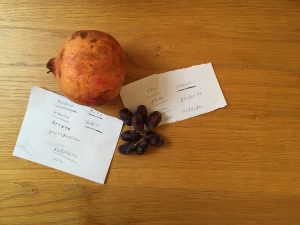
They would play football, or battle games. I would hear them running around the house and garden, shrieking “strike”, “wind”, and “fire” in Greek, as they zapped each other with magic powers. I aided the stealth-teaching by leaving ever-greater varieties and colours of fruit at the kitchen table: Pomegranate, red-grapes, green apples, sweet strawberries, orange oranges, sunshine bright lemons. 

About every third question, my boy would answer “baskalitsa, baskalitsa, baskalitsa” “Ladybird, ladybird, ladybird”. The colour of the sky today –  “baskalitsa”. Today you are wearing – “baskalitsa,”. Always with a grin, a pause, and then the right answer. 

But now he’s gone, and taken the sunshine and a masters in something techie, with him to go make his own life. 

My boy was bereft, even before he said goodbye. “Don’t go,” he said, quietly, tugging at his sleeve. Then “Baskalista, baskalitsa, baskalitsa” louder, this time. A binding-spell to tie him to us a little longer, or at least forever.

I saw in this goodbye, the other one, that my boy didn’t say to his father when he left home. My sweet blue-eyed boy said all his goodbyes in this one first big, 8-year-old’s goodbye.

We gave Stathis a small framed print of a ladybird to take home with him. I made him promise to invite us to holiday on his yacht when he becomes a tech zillionaire. 

And then  Stathis (“not staphili/grape”), wheeled his bike out of the hall and rode away. My boy and I held it together just long enough. We closed the door and turned clutching each other and lurched unsteadily to the sofa where I held my boy tightly, as he howled.

We were grief-stricken, which is not an exaggeration.

e.antoniou 2018